Impaired synthesis of both telomere strands and adaptive TERT reduction in RTEL1 ATPase-dead cells

Impaired synthesis of both telomere strands and adaptive TERT reduction in RTEL1 ATPase-dead cells
Wu, G.; Liu, M.; Zaug, A. J.; Rinn, J.; Cech, T. R.
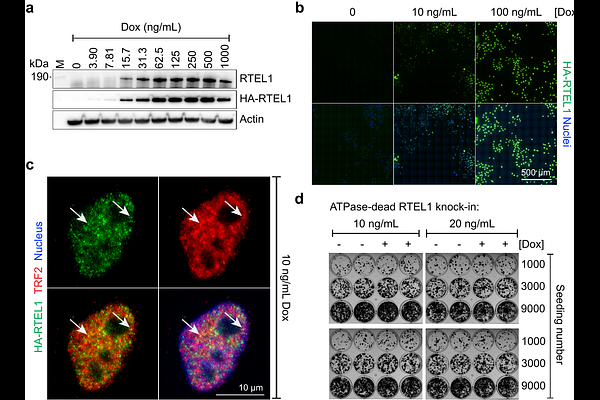
AbstractRegulator of Telomere Elongation Helicase 1 (RTEL1) plays a critical role in telomere replication by disassembling DNA secondary structures such as G-quadruplexes and telomeric loops (T-loops). However, its precise mechanism remains unclear. Previously, we generated HeLa cells homozygous for ATPase-dead RTEL1. Here, we found that these cells have a 50-60% reduction in the synthesis of both telomere strands, indicating that RTEL1 ATPase activity is essential for both leading-strand and lagging-strand synthesis. Surprisingly, these cells also showed a substantial reduction in Telomerase Reverse Transcriptase (TERT) mRNA levels and a 60-80% reduction in telomerase activity, without activating alternative lengthening of telomeres (ALT). Forced TERT overexpression suppressed proliferation and caused late S/G2 accumulation, implying that the natural TERT reduction provides adaptive resistance. Expressing wild-type (WT) RTEL1 at levels close to physiological levels failed to rescue growth defects, suggesting a dominant-negative effect. These results reveal unexpected interactions between RTEL1 and telomerase and show how cancer cells compensate for RTEL1 dysfunction by decreasing TERT expression.