The Euler Characteristic Transform Enables Classification of Complex Plant Shapes and Prediction of Leaf Venation from Blade Geometry

The Euler Characteristic Transform Enables Classification of Complex Plant Shapes and Prediction of Leaf Venation from Blade Geometry
Ayub, Y.; McGuire-Scullen, S.; Percival, S.; Weaver, W. N.; Karki, N.; Yahiaoui, W.; Astudillo-Pavon, K.; Barrios, A.; Check, J. C.; Colchado-Lopez, J.; Dolgikh, B. A.; Espinosa-Martinez, D. V.; Fu, Q.; Galvan-Lara, K. M.; Garcia-Chavez, J. N.; Garcia-Rios, S.; Grabb, C. N.; Guadir-Lara, G. E.; Hawkins, J. C.; Hendrickson, C. L.; Hightower, A. T.; Hurtado-Olvera, J. J.; Kianian, S.; Lennon, J.; Li, Z.; Li, J.; Lieb, B.; Lin, J.; Lopez-Sanchez, P.; Luna-Alvarez, M.; Martinez-Martinez, C.; Montemayor-Lara, a.; Moreno, N. A.; Obisesan, I. A.; Perez-Flores, O.; Pimentel-Ruiz, C.; Pineda-Hernandez,
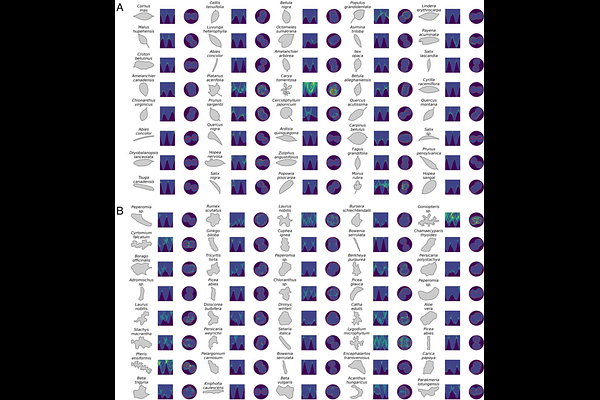
AbstractRationale: Quantifying and predicting plant morphology is central to understanding development and evolution, yet many plant forms lack homologous features required for traditional morphometrics. We apply the Euler Characteristic Transform (ECT), an injective descriptor from topological data analysis, to encode 2D plant shapes. The ECT converts contours into image-like representations that preserve shape information while enabling deep learning. Methods: We computed ECTs for large datasets of leaf and pavement cell shapes and used convolutional neural networks (CNNs) for classification. We also trained CNNs to approximate the inverse mapping, predicting leaf shape masks from radial ECTs. Key results: ECT-based models achieved high classification accuracy, surpassing previous approaches on millions of herbarium-derived leaves. Notably, grapevine leaf venation was predicted from blade geometry alone, demonstrating that vascular structure is encoded in the outline. Main conclusion: The ECT provides a compact, information-preserving representation of biological shape that integrates naturally with deep learning. It enables both accurate classification and predictive reconstruction, revealing latent morphological information and offering new opportunities to study plant form across scales.