Control problem in millimeter-wave adaptive optics

Control problem in millimeter-wave adaptive optics
Ichiro Jikuya, Yoichi Tamura
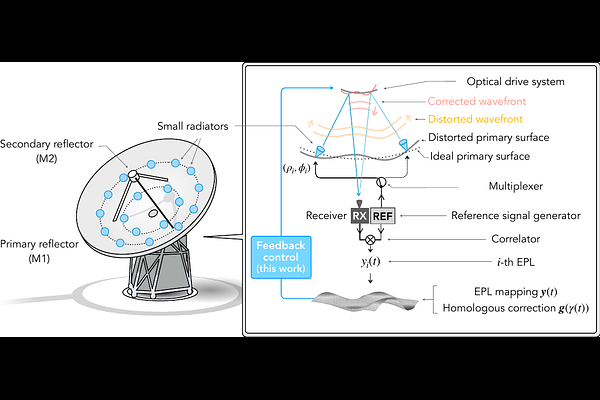
AbstractMillimeter-wave Adaptive Optics (MAO) is essential for high-precision large-aperture submillimeter telescopes, requiring real-time compensation of wavefront errors by capturing them as spatially-discrete excess path length (EPL) fluctuations. This paper presents a unified control-theoretic framework for the EPL compensation problem. We first model the optical drive system as a plant where input commands relate to measured EPL through a first-order system representing mechanical response delay and a measurement matrix characterizing the actuator-to-sensor coupling. We mathematically formulate the control task as an asymptotic disturbance suppression problem, specifically targeting low-frequency disturbances such as thermal and wind-induced deformations. Second, we propose an Anti-Windup Proportional-Integral (AWPI) control law. By employing a decoupling strategy, the design is reduced to a loop-shaping problem for decoupled scalar sensitivity functions, ensuring both stability margins and asymptotic disturbance suppression of constant-valued disturbances. The anti-windup mechanism is integrated to maintain control continuity during the recovery from saturation, preventing undesirable discontinuities in the drive command. Third, we introduce practical operational tools: a manual focus adjustment scheme that allows observer intervention without interfering with the feedback loop, and the cosine similarity index to quantify the suppressibility of specific Zernike modes. Numerical simulations, incorporating a three-axis secondary reflector drive and five-point EPL measurements, demonstrate direction-dependent disturbance rejection and the suppression of von Karman-modeled wind turbulence, validating the effectiveness of the proposed framework for real-world telescope applications.