NEXUS: Abundance, Environments, and Spectral Diversity of Little Red Dots from the NIRSpec MSA Sample

NEXUS: Abundance, Environments, and Spectral Diversity of Little Red Dots from the NIRSpec MSA Sample
Zhiwei Pan, Ming-Yang Zhuang, Yue Shen, Feige Wang, Jenny E. Greene, Adam J. Burgasser, Junyao Li, Zachary Stone, Padmavathi Venkatraman
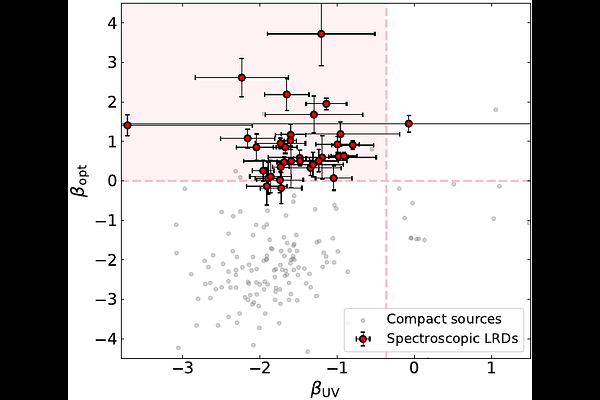
AbstractWe present a comprehensive study of Little Red Dots (LRDs) at 2.3 < z < 7.4 using NIRCam photometry and NIRSpec MSA/PRISM spectra from the ongoing NEXUS program. Photometric selection combining several commonly adopted methods yields a high completeness of about 85% for LRD selection over this redshift range and for a flux limit of F444W < 26. The overall purity is about 60%, with contamination from emission-line galaxies and normal active galactic nuclei (AGNs), as well as dwarf stars. Most (>90%) of the spectroscopically confirmed LRDs have robust broad-line detection. Our spectroscopic sample of 36 LRDs displays the full range of spectral diversity of LRDs. It includes objects with extreme Balmer breaks similar to the LRD "Cliff", as well as objects with moderately reddened rest-optical continua that can be fit with low-temperature blackbody components in the recent BH* model framework. The broad H$α$ emission is correlated with the continuum emission at 5100 Angstrom, suggesting common origins for these emission components; the narrow [O III] emission, however, is poorly correlated with the optical continuum. We do not find evidence of redshift evolution in these spectral properties. The space density of LRDs declines toward z about 2, opposite to the trend for normal AGNs, although low-luminosity LRDs at z about 2-4 may be more abundant than currently probed by ground-based searches. The clustering of LRDs suggests that they live in dark matter halos of several times $10^{11}\ h^{-1}$ solar masses, albeit with large uncertainties. Overall, these results are consistent with recent observations of LRDs and with the emerging picture of accreting SMBHs enshrouded in dense gas envelopes as the origin of LRDs.