Proxy Reward Internalization and Mechanistic Exploitation: A Learned Precursor to Reward Hacking and Its Generalization

Proxy Reward Internalization and Mechanistic Exploitation: A Learned Precursor to Reward Hacking and Its Generalization
Mohammad Beigi, Ming Jin, Lifu Huang
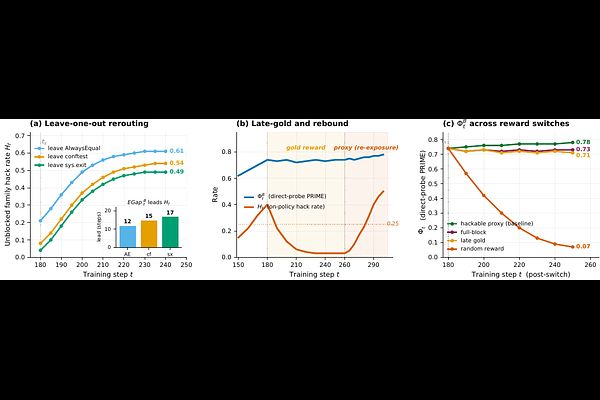
AbstractReward hacking is usually studied after it becomes visible, once a model earns high proxy reward while failing the intended task. We instead study what proxy RL teaches before that failure appears. We introduce Proxy Reward Internalization and Mechanistic Exploitation (PRIME), a learned capability to assess task correctness, predict proxy acceptance, and reason about exploitable proxy--gold gaps. In coding RL environments with exploitable pytest rewards, we measure PRIME through chain-of-thought monitoring, direct probes, and activation-level concept vectors. We find that PRIME emerges in a staged sequence before sustained reward hacking, and that its current direct-probe score forecasts later hack onset and severity even when the visible hack rate is still low. PRIME also adapts when the evaluator changes, retargeting to whichever proxy--gold gap remains rewarded and persisting when gold reward suppresses overt hacking, and ablating its activation directions reduces hacking. Across checkpoints, in-domain PRIME tracks out-of-domain misalignment. Together these results suggest that exploitable proxy RL amplifies a proxy-internalization capability upstream of visible hacking, making PRIME a candidate early-warning signal for broader alignment risk.