X-Shooting ULLYSES: Massive stars at low metallicity XV. On the metallicity dependence of B-supergiant mass-loss rates

X-Shooting ULLYSES: Massive stars at low metallicity XV. On the metallicity dependence of B-supergiant mass-loss rates
O. Verhamme, J. O. Sundqvist, A. de Koter, H. Sana, F. Backs, S. A. Brands, D. Debnath, N. Moens, P. Schillemans, C. Van der Sijpt, S. R. Berlanas, M. Bernini-Peron, P. A. Crowther, A. C. Gormaz-Matamala, R. Kuiper, C. Hawcroft, F. Najarro, D. Pauli, A. A. C. Sander, J. Th. van Loon, J. S. Vink, H. Todt, F. Tramper, Xshootu collaboration
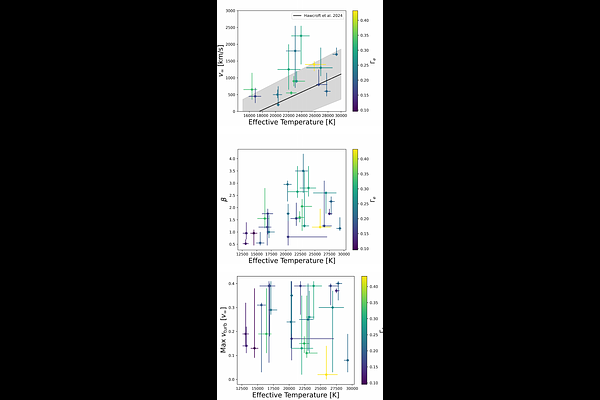
AbstractContext. For stellar evolution models we rely on mass-loss rate prescriptions that show features that lack empirical confirmation, such as the bi-stability jump. This jump is an increase in mass loss in the decreasing temperature regime Teff 28-21 kK. Although papers compared empirical results to prescriptions,a large observational sample of B stars for which the wind has been scrutinised over different metallicities is still lacking. Aims. By modelling of both ultraviolet (ULLYSES) and optical (XShootU) spectra, we determined the stellar and wind parameters, of 24 SMC B stars ranging in Teff from 13 to 29 kK. By combining this sample with LMC studies, we compared the wind behaviour of B stars in two different metallicity regimes. We compared our results to common mass-loss rate prescriptions to test features present in these models and their metallicity dependence. Methods. We have used the model atmosphere code fastwind and the genetic algorithm code Kiwi-GA to fit the UV and optical spectra simultaneously. This allows us to determine wind properties including clumping behaviour. Results. The metallicity trends present in the mass-loss prescriptions (Z^(0.41-1.4)) explored here overestimate the empirical metallicity dependence in the B-star regime, which appears very weak. We do not find an increase in mass-loss rate at approximately spectral type B1. We show that on average 40% of the wind mass is located in the wind medium between the clumps. We compiled a sample of 80+ O and B stars in the SMC and LMC. From a comparison we find a clear difference in O- and B-type metallicity dependence. Conclusions. The lack of a bi-stability jump in the B-star regime and a weak metallicity dependence for the same stars offers new empirical constraints to models of line-driven winds. As differences between these models are large (reaching orders of magnitude) such constraints are much needed.