Early metal-enriched baryon cycling before the midpoint of cosmic reionization

Early metal-enriched baryon cycling before the midpoint of cosmic reionization
Yongda Zhu, Zhiyuan Ji, George D. Becker, Jiani Ding, Eiichi Egami, Xiaohui Fan, Xiangyu Jin, Weizhe Liu, Jianwei Lyu, Zheng Ma, Suprabhas Narisetty, George H. Rieke, Yunjing Wu, Minghao Yue, Junyu Zhang, Marcia J. Rieke
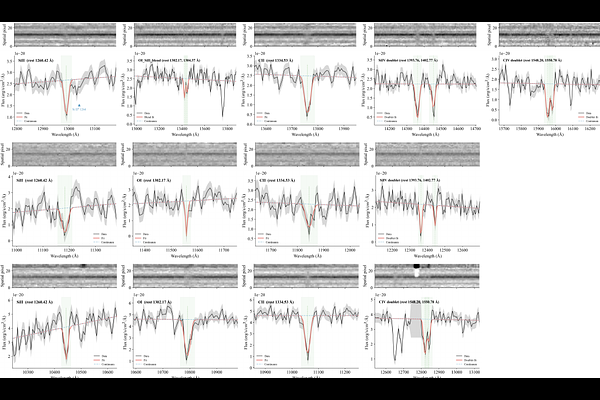
AbstractModels predict that chemical enrichment and gas redistribution should proceed rapidly once star formation begins, yet direct observational constraints at the earliest cosmic epochs have been scarce. Here we present evidence that metal-enriched gas in multiple ionic phases was already present around galaxies before the midpoint of cosmic reionization. Using JWST/NIRSpec rest-frame ultraviolet spectroscopy of three galaxies at redshifts $z=7.2-9.3$, we detect blueshifted metal absorption in all three systems; across the sample, the detected transitions span neutral, low-ionization, and high-ionization species, including O I, Si II, C II, Si IV, and C IV. These absorption features show velocity offsets of order $|Δv| \sim 50$--$250\,\mathrm{km\,s^{-1}}$, predominantly blueshifted relative to the systemic redshifts of the host galaxies derived from nebular emission lines. This ionic coexistence within a broadly shared velocity structure, together with the observed equivalent-width ratios, is consistent with outflowing or otherwise kinematically disturbed galaxy-associated gas, similar to that seen at lower redshift. The observations therefore indicate that metal-enriched gas associated with galaxies was already kinematically disturbed at very early times, requiring rapid metal production in the early generations of stars. These results show that key conditions for baryon cycling were established in at least a subset of luminous galaxies within the first several hundred million years of cosmic time, well before the completion of reionization.