Hierarchical Bayesian inference with compositional score modeling for stellar streams

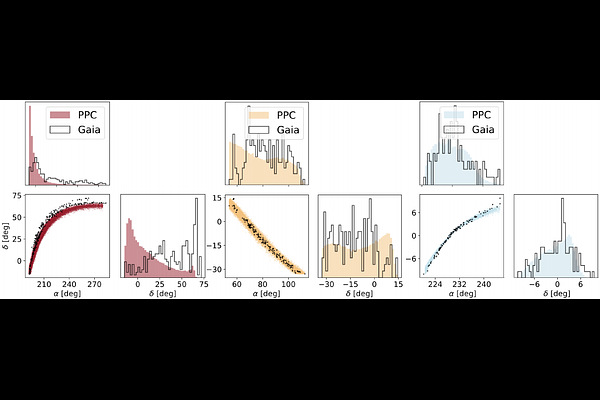
Hierarchical Bayesian inference with compositional score modeling for stellar streams
Giuseppe Viterbo, Jonas Arruda, Tobias Buck
AbstractContext: Stellar streams trace the gravitational potential of the Milky Way over a wide range of Galactocentric radii. Since different streams sample different regions of the Galaxy, combining several of them can constrain the global mass distribution more tightly than modeling any single stream in isolation. Most of the existing multi-stream analyses rely on likelihood-based methods that require a new inference run whenever additional streams or kinematic measurements become available. Aims: We aim to infer the Milky Way potential from multiple stellar streams combined with an additional constraint through the Galactic circular velocity curve within a single hierarchical framework. Methods: We model the problem hierarchically, separating parameters that are common to all streams from parameters that are specific to each progenitor. We train score-based neural posterior estimators on a library of simulated streams and combine information from different streams through compositional score modeling as a post-training step. Results: Tests on independent simulations show that the inferred posteriors are well calibrated and accurate. Combining several streams reduces the uncertainties on the global potential parameters relative to single-stream analyses. Applied to Gaia data, the model favours a mildly oblate dark matter halo with axis ratio $q_{NFW} = 0.77$, scale radius $a_{NFW} = 9.3$ kpc, a disk mass of $4.3 \times 10^{10} M_\odot$, and a local dark matter density $ρ_{NFW,\odot} = 0.01153 M_\odot pc^{-3}$ consistent with recent stream-based studies. Conclusions: This hierarchical framework provides a practical way to combine information from multiple stellar streams without repeating the full inference procedure for each new dataset. The method is adaptable to new datasets, like future Gaia DR4, or new spectroscopic surveys, with minimal computational cost.