Inflationary interpretation of the gravitational-wave signal in the European Pulsar Timing Array DR2 with constraints

Inflationary interpretation of the gravitational-wave signal in the European Pulsar Timing Array DR2 with constraints
Philippe Turgeon, Chiara Caprini, Anton Chudaykin, Martin Kunz, Delphine Perrodin, Ismael Cognard, Lucas Guillemot, Gilles Theureau
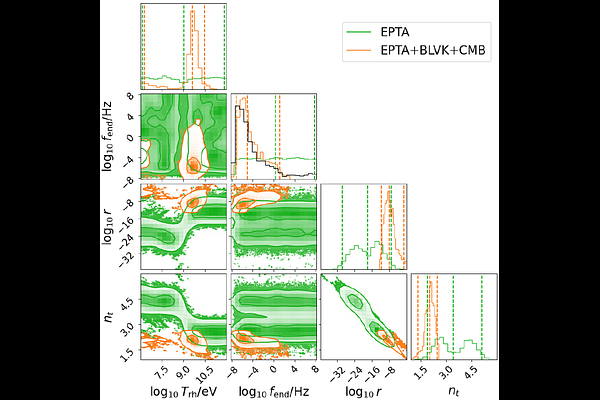
AbstractThe second data release of the European Pulsar Timing Array (EPTA) collaboration provides evidence for the presence of a gravitational-wave (GW) background. In this work, we explore a potential cosmological interpretation of this signal in terms of inflationary scenarios. We parametrize the tensor power spectrum in terms of the tensor-to-scalar ratio $r$, the tensor spectral index $n_t$, the reheating temperature $T_{\text{rh}}$, and the cut-off frequency $f_{\text{end}}$. We incorporate all relevant observational constraints, including those from the Cosmic Microwave Background, Big Bang Nucleosynthesis, and LIGO-Virgo-KAGRA observations. We demonstrate that imposing these constraints consistently reduces the region of parameter space that provides a viable interpretation of the EPTA signal, to $-11.66 \lesssim \log_{10}r \lesssim -1.45$, $1.32 \lesssim n_t \lesssim 2.47$, $1.78\text{ MeV} \lesssim T_{\text{rh}} \lesssim 28.2\text{ GeV}$, and $75.86\text{ nHz} \lesssim f_{\text{end}} \lesssim 14.45\text{ Hz}$ at the 95% confidence level. This favours the scenario in which the GW spectrum in the EPTA frequency band originates from tensor modes that re-entered the Hubble radius during the radiation-dominated era, allowing for a higher $r$ and a flatter spectrum. However, $T_{\text{rh}}$ must take very low values, which are challenging to explain theoretically.