Tracking Magnetic Topological Change in a Time-Dependent Coronal Model

Tracking Magnetic Topological Change in a Time-Dependent Coronal Model
Emily I. Mason, Cooper Downs, Roberto Lionello, Jon A. Linker, Viacheslav Titov
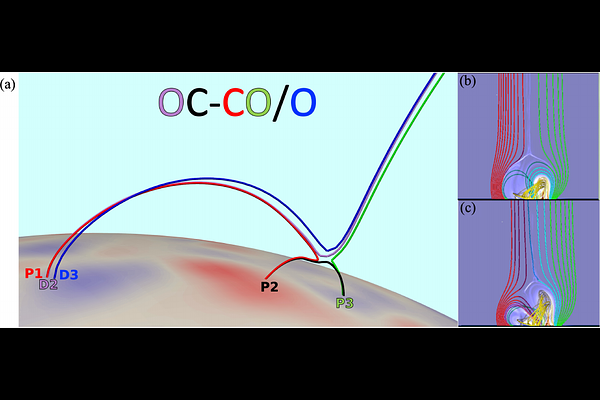
AbstractWe apply the slip-back mapping method of Titov et al. 2009 and Lionello et al. 2020 to a thermodynamic MHD simulation to track topological changes in the magnetic field at a range of temporal cadences. The method constitutes the logical successor to a simple open-field map for a steady-state model, as it tracks changes in the open and closed fields for a time-dependent model by tracking individual magnetic elements as they advect across the map, rather than simply tracing field line connectivity from each cell. Through careful categorization of the slip-back mapping values and analysis of the flux changes, we not only effectively track the open flux but can recover the flux processed through interchange reconnection as well. The field lines involved in these processes are shown to follow lines of high squashing factor, as proposed by interchange reconnection-driven slow solar wind theory. The time-dependent model, which is scaled to solar minimum-like activity, projects that a median value of 3.5% of the total open flux in any given 24-hour interval has been processed through interchange reconnection. This corresponds to a relatively high proportion of the total open flux changes over time in the heliosphere. Our results show that not only is this method a useful tool for accurately tracking topological change in time-dependent simulations, but that its inherent complexity can be visually reduced into an intuitive 2D plot that simply and effectively communicates temporal changes.