Informative Priors on Primordial Non-Gaussianity Bias $b_φ$ From Galaxy Formation

Informative Priors on Primordial Non-Gaussianity Bias $b_φ$ From Galaxy Formation
Anne Moore, Lucia A. Perez, Elisabeth Krause
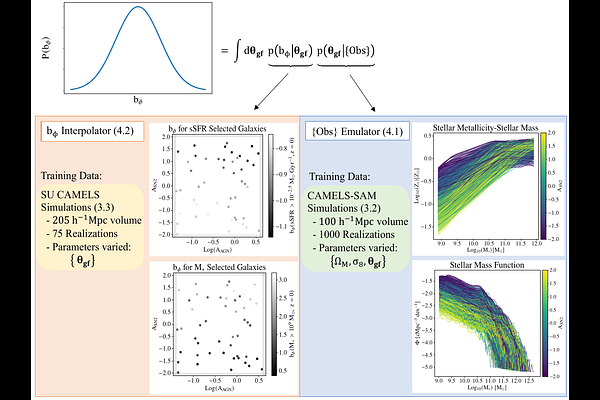
AbstractConstraining primordial non-Gaussianity via its scale-dependent imprint on galaxy clustering requires knowledge of the bias parameter $b_φ$, which is exactly degenerate with $f^{\rm{loc}}_{\rm{NL}}$ at leading order. To break this degeneracy, current analyses adopt the relation $\left(b_φ = 2δ_c\left(b_1 - 1\right)\right)$ based on the assumption of a universal mass function. This relation is known to break down for physically motivated galaxy selections, introducing systematic errors in the inferred $f^{\rm{loc}}_{\rm{NL}}$ that scale directly with the assumed $b_φ$ prior. We present a framework to construct physically motivated, observation-conditioned priors on $b_φ$ by marginalizing over galaxy formation uncertainties. We use the CAMELS-SAM simulation suite, augmented by separate Universe simulations, to measure galaxy formation observables, like the stellar mass function (SMF) and the stellar-to-halo mass relationship (SHMR), and $b_φ$ across a range of galaxy formation parameters. From these measurements, we construct a distribution of $b_φ$ conditioned on observations, and we select our galaxy sample to resemble the DESI Emission Line Galaxy (ELG) sample. Conditioning on the SMF or SHMR decreases $σ_{b_φ}$ from $0.69$ to $0.08$ and $0.02$ respectively -- reductions of $88\%$ and $97\%$ -- with consistent results when conditioning on the observed data directly. Despite substantial shifts in the galaxy formation posteriors driven by known SC-SAM discrepancies at high halo masses, the resulting $b_φ$ distributions remain mutually consistent across all observables. The SMF and SHMR are found to carry sufficient constraining power to reduce the galaxy formation uncertainty in $b_φ$ relevant for $f^{\rm{loc}}_{\rm{NL}}$ inference with next-generation spectroscopic surveys