DESI DR2 Baryon Acoustic Oscillations from the Lyman Alpha Forest Multipoles

DESI DR2 Baryon Acoustic Oscillations from the Lyman Alpha Forest Multipoles
N. G. Karaçaylı, A. Cuceu, J. Aguilar, S. Ahlen, S. Bailey, S. BenZvi, D. Bianchi, A. Brodzeller, D. Brooks, T. Claybaugh, A. de la Macorra, Biprateep Dey, P. Doel, J. Estrada, S. Ferraro, A. Font-Ribera, J. E. Forero-Romero, E. Gaztañaga, S. Gontcho A Gontcho, A. X. Gonzalez-Morales, G. Gutierrez, C. Hahn, H. K. Herrera-Alcantar, K. Honscheid, C. Howlett, M. Ishak, R. Joyce, R. Kehoe, D. Kirkby, T. Kisner, A. Kremin, O. Lahav, M. Landriau, J. M. Le Goff, L. Le Guillou, M. E. Levi, M. Manera, P. Martini, A. Meisner, R. Miquel, J. Moustakas, A. Muñoz-Gutiérrez, S. Nadathur, N. Palanque-Delabrouille, W. J. Percival, F. Prada, I. Pérez-Ràfols, G. Rossi, E. Sanchez, D. Schlegel, M. Schubnell, H. Seo, J. Silber, D. Sprayberry, G. Tarlé, B. A. Weaver, R. Zhou, H. Zou
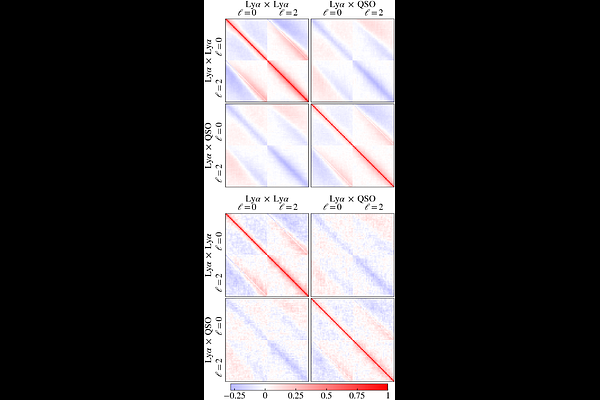
AbstractWe present an alternative measurement of the Baryon Acoustic Oscillation (BAO) using Legendre multipole representation of the Ly$α$ forest correlation functions from the second data release (DR2) of the Dark Energy Spectroscopic Instrument survey. Compressing the auto- and cross-correlation functions into Legendre multipoles yields a positive-definite covariance matrix without any smoothing -- unlike the baseline DR2 analysis -- thanks to a significantly reduced data vector size. We introduce the statistical corrections required to debias the finite-sample covariance matrix estimate and demonstrate that monopole and quadrupole terms for both auto- and cross-correlations can be used even when the correlation functions are distorted by continuum errors and contaminated by metals. This formalism has slightly diminished the constraining power of the BAO scale, while considerably weakening constraints on nuisance parameters. We measure the isotropic BAO scale with $0.96\%$ precision at $z_\mathrm{eff}=2.35$, the Hubble parameter $H(z_\mathrm{eff})=(238.7\pm3.4)~(147.09~\mathrm{Mpc}/r_d) ~\mathrm{km~s}^{-1}~\text{Mpc}^{-1}$, and the transverse comoving distance $D_M(z_\mathrm{eff})=(5.79 \pm 0.10)~(r_d/147.09~\mathrm{Mpc})$~Gpc for a given value of the sound horizon ($r_d$). Our BAO results are entirely consistent with the baseline DR2 analysis.