Spectral distortion anisotropies from photon to dark photon conversions

Spectral distortion anisotropies from photon to dark photon conversions
Sara Evangelista, Jens Chluba, Bryce Cyr
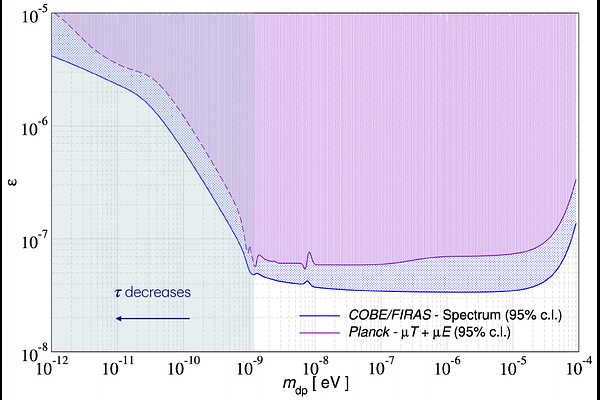
AbstractDark photons are a gauge boson of a hypothetical dark sector, representing one of the most-studied minimal extensions of the Standard Model, with wide-ranging theoretical and observational implications. Here, we consider scenarios in which an initially unpopulated dark photon sector is populated via resonant photon to dark photon conversions. This process leads to observable spectral distortions in the cosmic microwave background (CMB), that can be used to constrain these models. We extend previous spectral distortion studies of the monopole spectrum to anisotropic spectral distortions, using the newly developed Frequency Hierarchy (FH) framework of CosmoTherm. We illustrate the physics by presenting detailed computations of the photon transfer functions and distortion cross power spectra throughout the dark photon parameter space. We find that the dark photon mass explicitly controls the shape (i.e., multipole-dependence) of the signal power spectra, while the overall amplitude of the signal is determined by the kinetic mixing parameter of the model. Using these results, we place complementary limits on the minimal dark photon model using data from Planck, finding that the constraints are only marginally weaker than those obtained with COBE/FIRAS data for the average (monopole) distortion. In addition, we compute the corrections to the standard temperature field, arguing that conversions at redshifts larger than $2\times 10^6$ may add iso-curvature type perturbations, which could lead to novel constraints in regimes where distortion anisotropies thermalize.