Complexity-driven transitions in quantum observation

Complexity-driven transitions in quantum observation
Zhenyu Du, Siyuan Cheng, Han Ye, Junjie Chen, Xiao Yuan, Xiongfeng Ma
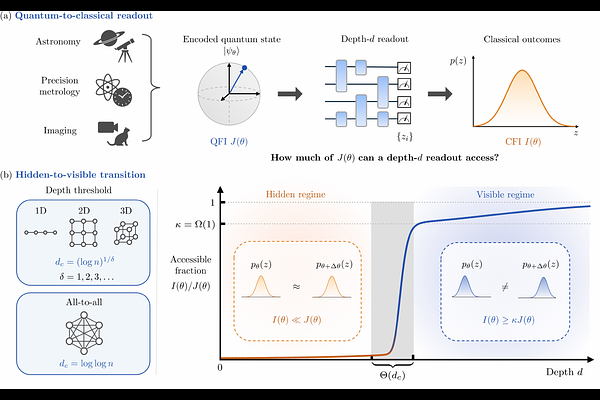
AbstractObserving the physical world is a foundational pursuit in science. In the quantum realm, however, observation necessitates a fundamental quantum-to-classical conversion: destructive measurements irreversibly project quantum states into classical data, inevitably incurring a loss of information. What physical principles govern this information loss, and how can we construct optimal measurements to maximize the readout? Here, we address these questions by establishing an intrinsic relationship between readout capability--quantified by the ratio of accessible classical Fisher information to the total quantum Fisher information (QFI), and measurement complexity--defined as the quantum circuit depth required prior to projection. Remarkably, we uncover a sudden emergence of observability: a sharp hidden-to-visible transition driven entirely by measurement complexity. We rigorously prove that below critical depth thresholds--$Θ((\log n)^{1/δ})$ for $δ$-dimensional architectures and $Θ(\log\log n)$ for all-to-all connectivity--readout capability decays exponentially with system size $n$, rendering the quantum information fundamentally inaccessible. Surprisingly, immediately above this threshold, the system enters a visible regime: we demonstrate that randomized measurements universally recover a constant fraction of the QFI using approximate unitary 3-designs, for which we explicitly develop optimal-depth circuit constructions tailored to finite-dimensional architectures. By unveiling the fundamental scaling laws and transitions that govern quantum observation, our results delineate definitive resource boundaries for quantum learning, state certification, and quantum metrology.