A Selection Aware View of Black Hole-Galaxy Coevolution at High Redshift

A Selection Aware View of Black Hole-Galaxy Coevolution at High Redshift
Francesco Ziparo, Stefano Carniani, Simona Gallerani, Bartolomeo Trefoloni
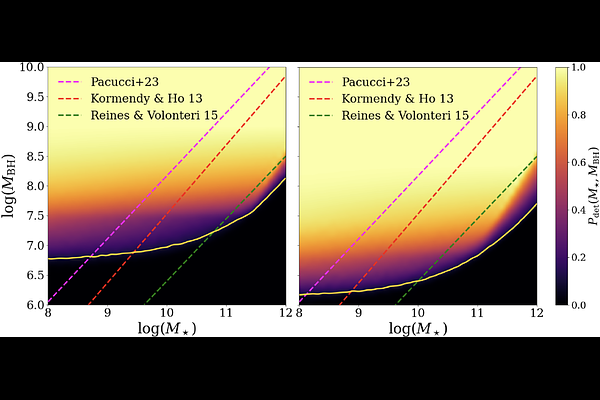
AbstractThe large population of broad-line Active Galactic Nuclei (AGN) observed with the James Webb Space Telescope (JWST) at $z \gtrsim 4$ opens a new window onto the black hole-galaxy connection in the first Gyr of cosmic history. We use the JADES survey-level dataset and develop a forward-modeling Bayesian framework that explicitly accounts for broad H$α$ detectability, ensuring that selection effects are incorporated into the likelihood function. With this approach, we constrain the black hole-stellar mass ($M_{\mathrm{BH}}$-$M_\star$) relation to be $\log M_{\rm BH} = -4.06^{+0.50}_{-0.51} + 1.17^{+0.06}_{-0.06}\,\log M_\star$, with an intrinsic orthogonal scatter of $σ_{\rm int} = 0.63^{+0.14}_{-0.11}$ dex. The slope and normalization are consistent with local determinations, indicating that the average scaling was already established by $z \sim 4$-6. This suggests that the primary evolution of the relation occurs in its dispersion rather than in its mean normalization. In contrast, the substantially larger intrinsic scatter relative to the nearby Universe reveals a wider diversity of black hole-galaxy growth histories, likely driven by bursty accretion, delayed feedback, and differences in merger or seeding histories. Future JWST samples will be crucial to test whether this increased scatter is a persistent feature of the high-redshift Universe.