Graph Learning on Ensembles of Cyclic Peptides: An Investigation of Molecular Ensemble Modeling

Graph Learning on Ensembles of Cyclic Peptides: An Investigation of Molecular Ensemble Modeling
Aaron Feller, Kris Deibler, Maxim Secor
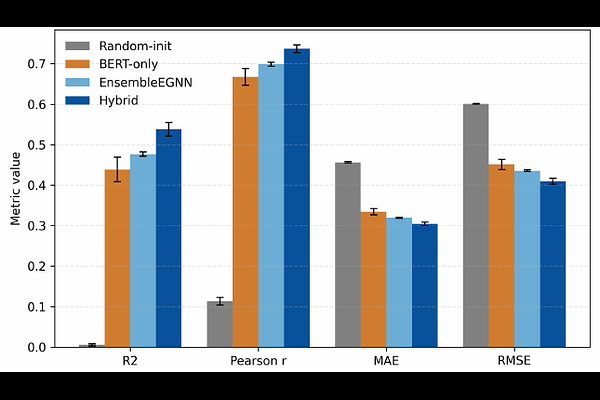
AbstractMolecular property prediction from structure often uses a single representative conformation, even though many molecules exist as conformational ensembles in solution. We introduce EnsembleEGNN, a molecular ensemble foundation model that encodes an ensemble by first encoding each conformer with shared Equivariant Graph Neural Network (EGNN) layers, then pooling the resulting conformer representations with a Set Attention Block. We pretrain the model on CREMP, a cyclic peptide ensemble dataset, using a multi-task self-supervised objective combining masked token recovery, noisy-coordinate reconstruction, and pairwise distance reconstruction. On the CREMP-CycPeptMPDB dataset, training EnsembleEGNN from scratch fails entirely ($R^2=0.005$). However, the pretrained model reaches $R^2=0.477$ and Pearson $r=0.699$, outperforming the sequence-only BERT baseline ($R^2=0.439$, Pearson $r=0.667$). When EnsembleEGNN is co-trained end-to-end with the BERT sequence encoder, the hybrid model improves further to $R^2=0.538$ and Pearson $r=0.737$. These results demonstrate that encoding conformational ensembles into a single thermodynamically informed embedding improves cyclic-peptide property prediction.