Quantum resource localizability transitions in deep thermalization

Quantum resource localizability transitions in deep thermalization
Xiaozhou Feng, Chang Liu, Zihan Cheng, Wen Wei Ho, Matteo Ippoliti
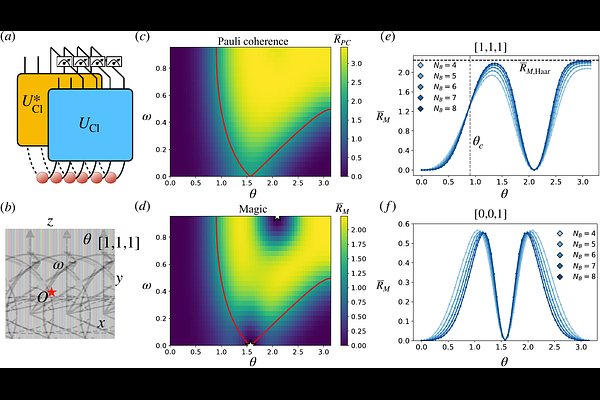
AbstractWe investigate how quantum resource constraints affect deep thermalization, the emergence of universal local wavefunction distributions from partial measurements of a quantum many-body state. Quantum resources, such as non-stabilizerness (magic), coherence, asymmetry, imaginarity, and non-Gaussianity, are essential for quantum information processing, and constraints on their global abundance can reshape these emergent distributions. To address this question, we develop a unified framework for deep thermalization within general quantum resource theories (QRTs). Our central result is that QRTs fall into two classes: ``smoothly localizable'' (SL) QRTs, where the resource content of local post-measurement states changes continuously with the global resource density, set by the initial state and measurement basis, yielding continuously tunable wavefunction distributions; and ``threshold localizable'' (TL) QRTs, where the local resource content jumps discontinuously from minimal to near-maximal past a critical global resource threshold, producing a sharp transition between a resourceless, ``deep-ergodicity breaking'' distribution and a resourceful, maximally random one. We trace this SL-TL dichotomy to an information-theoretic mechanism, block sharpening: by viewing each QRT as coherence between blocks in Hilbert space, we show that the local resource content depends on the measurement's ability to collapse an initial superposition into a single resourceless block. Our theory is analytically tractable and quantitatively predicts the phase boundaries across all studied QRTs, which we validate with extensive numerical simulations. Finally, we highlight two consequences: a novel magic transition in zero-rate quantum error-correcting codes--previously believed to occur only at finite rates--and new implications for quantum resource certification protocols based on post-measurement state ensembles.