MINDS: Intertwined evolution of dust and gas in large planet-forming disks. A diversity driven by halted pebble drift?

MINDS: Intertwined evolution of dust and gas in large planet-forming disks. A diversity driven by halted pebble drift?
Benoît Tabone, Milou Temmink, Laurens B. F. M. Waters, Ewine F. van Dishoeck, Andrew Sellek, Pacôme Estève, Nicolas T. Kurtovic, Inga Kamp, Thomas Henning, Danny Gasman, Sierra L. Grant, József Varga, Alice Guerras, Dmitry Semenov, Aditya M. Arabhavi, Alessio Caratti o Garatti, Anne Dutrey, Edwige Chapillon, Stéphane Guilloteau, Manuel Güdel, Hyerin Jang, Till Kaeufer, Jayatee Kanwar, Göran Olofsson, Giulia Perotti, Vincent Piétu, Thomas P. Ray, Marissa Vlasblom
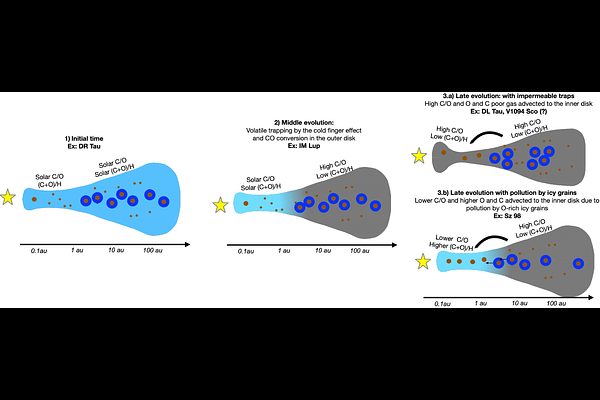
Abstract(Abridged) We aim to investigate the inner regions of large and massive disks orbiting T Tauri stars, thought to be progenitors of systems with wide-orbit planets and possible cases of halted pebble drift. We analyze the MIRI spectra of three disks from the MINDS program: V1094 Sco, DL Tau, and IM Lup. The spectra reveal a striking diversity. V1094 Sco and DL Tau exhibit the highest C$_2$H$_2$/H$_2$O flux ratio in the MINDS sample of T Tauri disks. In V1094 Sco, even cold C$_4$H$_2$ is seen. In contrast, the IM Lup spectrum is dominated by O-bearing species. No one-to-one correspondence is found between the gas in the outer disk, as traced by the C$_2$H/C$^{18}$O flux ratio, and that of the inner disk as traced by the C$_2$H$_2$/H$_2$O flux ratio. To explain these results, we propose a scenario based on a toy model of halted pebble drift. We show that a volatile C/O ratio close to unity and low C and O abundances in inner disks arise only if: (1) ~95$\%$ of the icy grains are blocked in the outer disk, (2) the outer disk is chemically evolved, and (3) the gas in the outer disk has had time to reach the inner disk. DL Tau and perhaps V1094 Sco would be the rare examples for which all these conditions are met. Therefore, a high C$_2$H$_2$/H$_2$O flux ratio in pebble-rich disks would have a different origin than proposed for very-low mass stars, for which fast drift of O-rich pebbles would eventually leave a C-rich inner disk. We also show for the first time that the disks with high C$_2$H$_2$/H$_2$O flux ratio exhibit a prominent silica dust component, a result found in four disks published so far (V1094 Sco, DL Tau, CY Tau, DoAr 33). We propose that the reformation of dust at the sublimation front of silicates in a gas with super-solar (but below unity) C/O ratio leads to a silica stoichiometry (SiO$_2$). In turn, silica is a promising diagnostic of the C/O ratio in the inner disks.