Gauging the Impact of Cosmic Ray Feedback on the Stellar Initial Mass Function

Gauging the Impact of Cosmic Ray Feedback on the Stellar Initial Mass Function
Margot Fitz Axen, Stella S. R. Offner, Philip F. Hopkins, Michael Y. Grudić
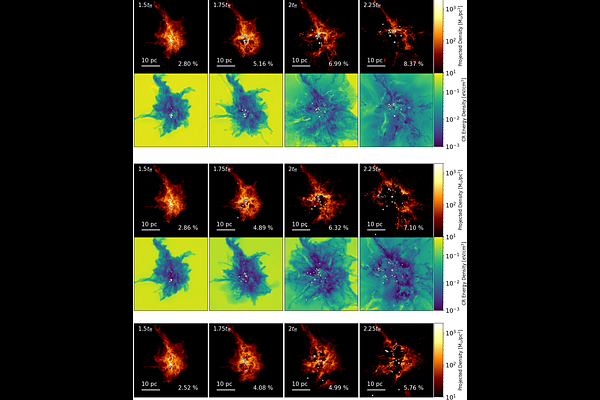
AbstractCosmic rays (CRs) drive ionization and influence gas dynamics in molecular clouds (MCs), potentially impacting the resulting star formation outcomes. Although previous simulations of individual star formation have included methods for cosmic ray transport (CRT), none have been large enough to resolve the stellar initial mass function (IMF). We conduct numerical simulations following the collapse of a $20000 M_{\odot}$ MC and the subsequent star formation including CRT, both with and without CRs accelerated by winds from the young massive stars, and compare against a non-CRT simulation. We show that after the first massive stars form, the cavity produced by feedback is more pronounced in the CRT simulations because the external CRs are able to propagate inwards and compress the gas into higher density structures. This increases the subsequent star formation in the cloud; by the end of the simulation, the SFE in the CRT simulation including stellar wind CRs is 43 \% higher than the non-CRT simulation. The IMF is also top heavy in comparison, with a slope above 1 $M_{\odot}$ that is shallower by $\sim 20$ \%. These effects are also present in the simulation without wind-accelerated CRs, but they are not as pronounced; the SFE is only 16 \% higher than the non-CRT simulation, and the IMF high-mass slope is shallower by $\sim 10$ \%. These results may explain some of the observed top-heavy IMFs, which typically occur in high-CR environments such as the galactic center.