High-Resolution [CI] $({^3\mathrm{P}_2}\rightarrow{^3\mathrm{P}_1})$ and CO $(J=7\rightarrow6)$ Observations of Circumnuclear Disks in Nearby Seyfert Galaxies

High-Resolution [CI] $({^3\mathrm{P}_2}\rightarrow{^3\mathrm{P}_1})$ and CO $(J=7\rightarrow6)$ Observations of Circumnuclear Disks in Nearby Seyfert Galaxies
Dragan Salak, Suphakorn Suphapolthaworn, Yusuke Miyamoto, Naomasa Nakai, Masumichi Seta, Kazuo Sorai
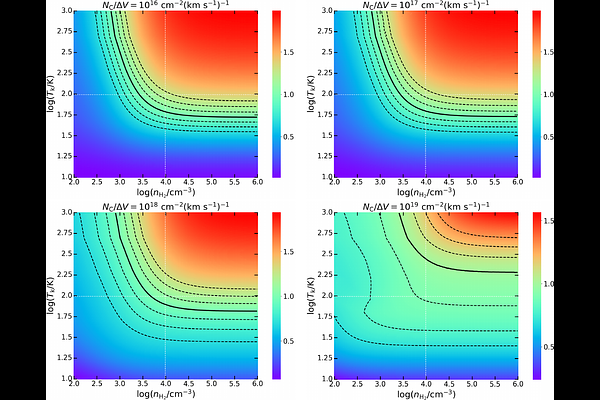
AbstractWe present [CI] $({^3\mathrm{P}_2}\mathrm{-}{^3\mathrm{P}_1})$, CO $(J=7\mathrm{-}6)$, and 800-GHz continuum observations of the circumnuclear disks (CNDs) in the Seyfert galaxies NGC 613 and NGC 1808 with the Atacama Large Millimeter/submillimeter Array. The images reveal the distributions of neutral gas and dust in nearby galaxy nuclei at a resolution of $0.2''$ (10 pc) which is unprecedented at these frequencies. Both lines and continuum exhibit peaks at the position of molecular tori. The maximum [CI]$({^3\mathrm{P}_2}\mathrm{-}{^3\mathrm{P}_1})/({^3\mathrm{P}_1}\mathrm{-}{^3\mathrm{P}_0})$ integrated-intensity ratio is $\approx1.1$ $(\mathrm{K~km~s}^{-1}$ scale) in the region of the torus, yielding an excitation temperature of $T_\mathrm{ex}\approx60~\mathrm{K}$ under the approximation of local thermodynamic equilibrium (LTE) and optically thin emission. A non-LTE radiative transfer analysis of the [CI] line ratio in the CND constrains the density and kinetic temperature of molecular gas to $n_\mathrm{H_2}>10^3~\mathrm{cm}^{-3}$ and $T_\mathrm{k}>50~\mathrm{K}$, respectively. To estimate the C/CO abundance ratio and physical conditions, we simultaneously modeled the [CI] and multiple CO lines, and obtained solutions with densities and temperatures of $n_\mathrm{H_2}\sim10^{3\mathrm{-}4}~\mathrm{cm}^{-3}$ and $T_\mathrm{k}\sim80\mathrm{-}250~\mathrm{K}$ in the central 63 pc. The C/CO ratios are $\approx2$ in NGC 613 and $\approx0.6$ in NGC 1808. C/CO tends to increase with $T_\mathrm{k}$ and decrease with $n_\mathrm{H_2}$ in the CND, which is consistent with models of photodissociation regions. Based on the kinematics of gas traced by [CI] $({^3\mathrm{P}_2}\mathrm{-}{^3\mathrm{P}_1})$ and CO $(J=7\mathrm{-}6)$, the mass of the supermassive black hole at the center of NGC 613 is estimated to be $\sim2\times10^7~M_\odot$.