One's loss is (not) another's gain: Isotropic re-emission destabilizes mass transfer from radiative donor stars

One's loss is (not) another's gain: Isotropic re-emission destabilizes mass transfer from radiative donor stars
K. D. Temmink, S. Justham, O. R. Pols
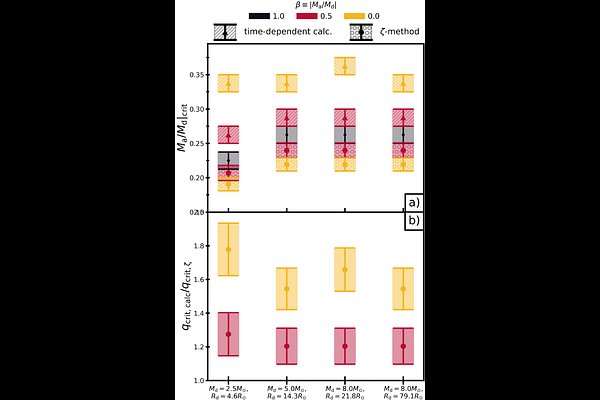
AbstractNon-conservative mass transfer plays a central role in close-binary evolution, yet its effects on mass-transfer stability are uncertain. One widely adopted prescription, isotropic re-emission, is often assumed to promote stability compared to conservative mass transfer. We investigate the impact of isotropic re-emission on the stability of mass transfer in binaries with radiative envelopes that undergo delayed dynamical instability (DDI). We assess whether simplified criteria used in binary population synthesis codes accurately capture stability boundaries under varying mass-transfer efficiencies. We perform detailed stellar evolution calculations for a set of representative binaries undergoing DDI. Varying the mass-transfer efficiency beta, we track the onset of instability and quantify the corresponding critical mass ratio. We compare our results with predictions from the commonly used zeta-method, which is based on mass-radius exponents. We find that a lower mass-transfer efficiency destabilizes mass transfer in DDI systems, whereas the zeta-method predicts that isotropic re-emission should stabilize it. The discrepancy arises because the zeta-method fails to capture the full evolution of the orbit and mass ratio during pre-instability mass transfer. In some cases, the critical mass ratio is underestimated by nearly a factor of two. Our findings show that isotropic re-emission can reduce, rather than enhance, DDI stability, underscoring the limitations of using fixed critical mass ratios and zeta-based criteria. This highlights the need for calibrated prescriptions that capture the time-dependent evolution of mass ratio and orbital separation, with direct implications for modelling X-ray binaries, symbiotic stars, and double white dwarfs, including their transient rates and delay-time distributions.