Discovery of a $z\simeq 4.9$ Lyman-$α$ Emitter Protocluster: Wavelength-Dependent Environmental Effects on Galaxy Structure

Discovery of a $z\simeq 4.9$ Lyman-$α$ Emitter Protocluster: Wavelength-Dependent Environmental Effects on Galaxy Structure
Ronaldo Laishram, Yusei Koyama, Haruka Kusakabe, Satoshi Kikuta, Shunta Shimizu, Tadayuki Kodama
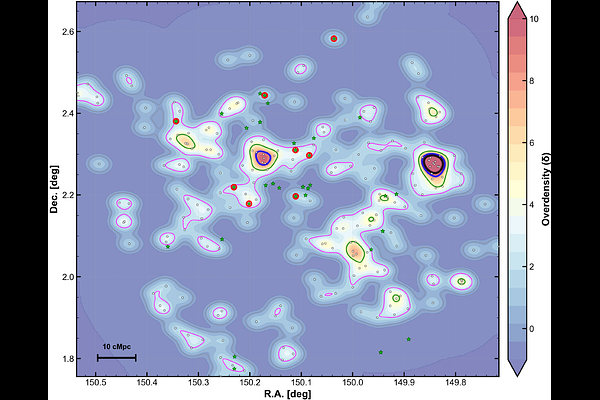
AbstractWe report the discovery of a Lyman-alpha emitter (LAE) protocluster at z = 4.90 in the COSMOS field, comprising four distinct overdensity peaks spanning ~65 x 36 cMpc^2, with the primary concentration exhibiting a 4-fold surface density enhancement relative to the field within a 1.5 proper Mpc (pMpc) radius. Using SILVERRUSH narrowband survey data combined with JWST COSMOS-Web imaging, we perform a first systematic rest-frame optical and UV morphological comparison of protocluster versus field LAEs at this redshift using JWST NIRCam rest-frame UV (F150W, ~2540 Angstrom) and optical (F277W, ~4700 Angstrom) imaging. Sersic profile fitting for 16 protocluster members and 23 field LAEs reveals a significant size difference: protocluster LAEs are ~40% larger in rest-optical (median R_e = 0.81+0.26/-0.04 kpc vs. 0.58+0.11/-0.04 kpc, p = 0.041) with no significant difference in rest-UV (p = 0.51) or Sersic index. At fixed stellar mass, protocluster LAEs are offset by +0.12 dex (~31%) in rest-optical size from the field size-mass relation (68% CI: [+0.08, +0.21]; Mann-Whitney p = 0.033), with 75% exhibiting positive size residuals compared to 44% of field LAEs. This wavelength-dependent environmental signature suggests that protocluster environments at z ~ 5 preferentially affect extended stellar populations, possibly through tidal interactions or an earlier onset of star formation in the dense environment, with no significant environmental difference detected in rest-UV sizes, providing observational evidence for environmental influences on the structure of LAEs during the early build-up phase of cosmic star formation.