Exploring the statistical anisotropy of primordial curvature perturbations with pulsar timing arrays

Exploring the statistical anisotropy of primordial curvature perturbations with pulsar timing arrays
Fengting Xie, Zhi-Chao Zhao, Qing-Hua Zhu, Xin Li
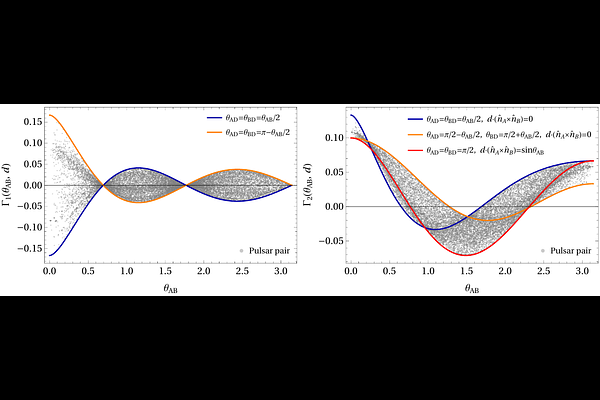
AbstractThe recent detection of a stochastic gravitational wave background by pulsar timing arrays has opened a new window in understanding supermassive black hole binaries and in probing the universe at the early time. Recently, pulsar timing array (PTA) collaborations have been further paving the way to probe anisotropies in the stochastic gravitational wave background. This study investigates dipole-type statistical anisotropy in the primordial power spectrum within a phenomenological framework. We demonstrate that the primordial dipole induces both dipolar and quadrupolar anisotropies in the energy density spectrum of scalar-induced gravitational waves (SIGWs), without generating extra polarization modes. Based on this anisotropic spectrum, we derive the corresponding PTA overlap reduction functions (ORFs), which exhibit frequency dependence, with the anisotropies enhanced on small scales. Furthermore, owing to the non-uniform distribution of millisecond pulsars over the sky in current PTA dataset, the ORFs exhibit a morphology that explicitly depends on the preferred direction of the anisotropy. However, our bayesian analysis of the NANOGrav 15-year dataset still yields no significant evidence for a preferred direction and a weak upper limit on anisotropy amplitude $(g\lesssim0.5)$. This result arises because the observational frequency band lies below the spectral peak, where our models predict suppressed anisotropic contributions. This limitation highlights the potential of future PTA observations. Specifically, datasets with broader frequency coverage are expected to tighten constraints on dipole-type anisotropy.