SELDON: Supernova Explosions Learned by Deep ODE Networks

SELDON: Supernova Explosions Learned by Deep ODE Networks
Jiezhong Wu, Jack O'Brien, Jennifer Li, M. S. Krafczyk, Ved G. Shah, Amanda R. Wasserman, Daniel W. Apley, Gautham Narayan, Noelle I. Samia
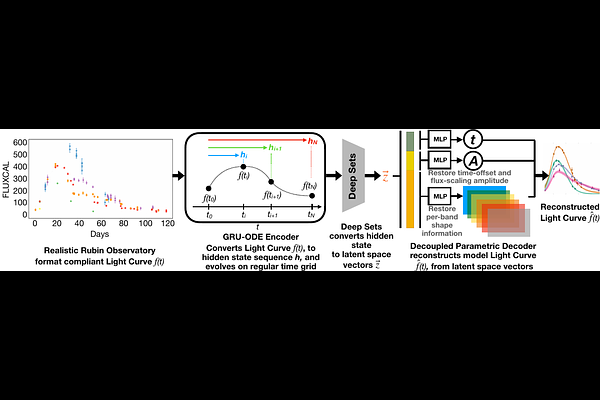
AbstractThe discovery rate of optical transients will explode to 10 million public alerts per night once the Vera C. Rubin Observatory's Legacy Survey of Space and Time comes online, overwhelming the traditional physics-based inference pipelines. A continuous-time forecasting AI model is of interest because it can deliver millisecond-scale inference for thousands of objects per day, whereas legacy MCMC codes need hours per object. In this paper, we propose SELDON, a new continuous-time variational autoencoder for panels of sparse and irregularly time-sampled (gappy) astrophysical light curves that are nonstationary, heteroscedastic, and inherently dependent. SELDON combines a masked GRU-ODE encoder with a latent neural ODE propagator and an interpretable Gaussian-basis decoder. The encoder learns to summarize panels of imbalanced and correlated data even when only a handful of points are observed. The neural ODE then integrates this hidden state forward in continuous time, extrapolating to future unseen epochs. This extrapolated time series is further encoded by deep sets to a latent distribution that is decoded to a weighted sum of Gaussian basis functions, the parameters of which are physically meaningful. Such parameters (e.g., rise time, decay rate, peak flux) directly drive downstream prioritization of spectroscopic follow-up for astrophysical surveys. Beyond astronomy, the architecture of SELDON offers a generic recipe for interpretable and continuous-time sequence modeling in any time domain where data are multivariate, sparse, heteroscedastic, and irregularly spaced.