What could an emerging Big Bang Nucleosynthesis discrepancy be hinting at?

What could an emerging Big Bang Nucleosynthesis discrepancy be hinting at?
Vivian Poulin, Julien Froustey, Cyril Pitrou, Tristan L. Smith
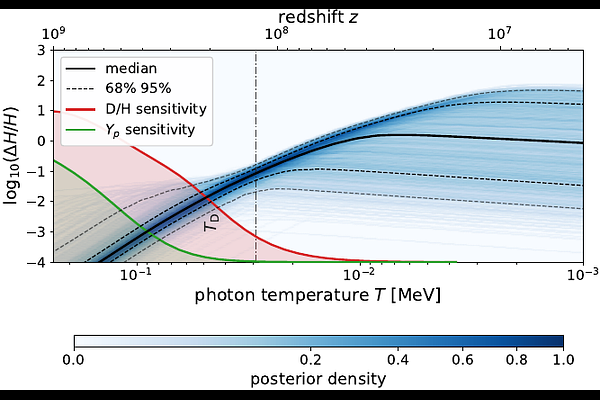
AbstractThe latest measurement of the primordial deuterium abundance is in $\sim 2σ$ tension with several state-of-the-art predictions of standard Big Bang nucleosynthesis (BBN), when using the baryon density inferred from the $Λ$CDM model fit to cosmic microwave background (CMB) data. This tension increases to $\sim 3σ$ for models attempting to solve the Hubble tension, such as early dark energy (EDE), which generally predict a larger baryon density than in $Λ$CDM. We test whether this discrepancy could be pointing to a non-standard expansion history during BBN. We compute light-element abundances with PRIMAT and compare $Λ$CDM, a $ΔN_{\rm eff}$ extension, and a very early dark energy (vEDE) component. For vEDE, we sample $ΔH/H$, the fractional increase of the expansion rate while deuterium burning is freezing out and helium-4 fusion is mostly over. The Bayesian analysis using BBN plus the CMB baryon-density constraint in the EDE cosmology gives $ΔH/H = 0.087^{+0.036}_{-0.037}$ during the deuterium burning epoch, i.e. at a temperature $T_{\rm D}\simeq0.03\,{\rm MeV}$, and no residual tension. The vEDE component preserves the observed deuterium abundance at the larger CMB baryon density while only mildly affecting helium-4. By contrast, extra radiation raises the helium-4 abundance too efficiently and does not reconcile the baryon density determinations. Together with inflation, dark energy, and EDE, our results hint at the presence of another light scalar field in cosmology.