Delving into the depths of NGC 3783 with XRISM: V. Broad-band modeling of ionized outflows

Delving into the depths of NGC 3783 with XRISM: V. Broad-band modeling of ionized outflows
Keqin Zhao, Jelle S. Kaastra, Liyi Gu, Missagh Mehdipour, Megan E. Eckart, Keigo Fukumura, Matteo Guainazzi, Chen Li, Christos Panagiotou, Matilde Signorini
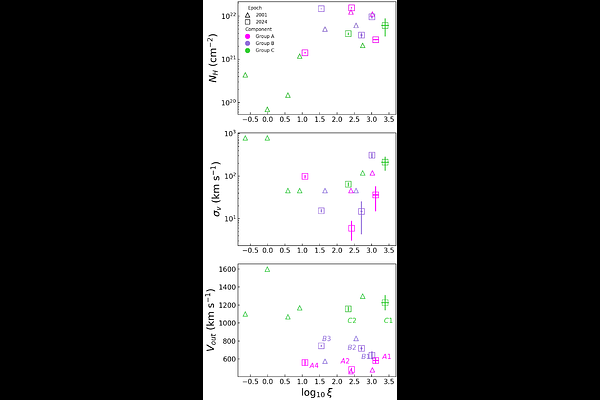
AbstractThe Seyfert 1 galaxy NGC 3783 hosts a multiphase warm absorber (WA) that has been extensively studied in the X-ray band. High-resolution spectra from 2000-2001 revealed a complex outflow with multiple ionization and velocity components. Two decades later, new XMM-Newton and XRISM observations allow us to investigate the long-term evolution of these outflows. We perform joint spectral modeling of the XMM-Newton/RGS and XRISM/Resolve time-averaged spectra using the pion photoionization code within SPEX. We derive the ionization parameter, column density, turbulent velocity, and outflow velocity for each absorption component, and investigate their thermal stability and Absorption Measure Distribution (AMD) to characterize the physical and dynamical properties of the WA in NGC 3783 in 2024. We compare these results with the 2000-2001 epoch to assess long-term variability, stability, and possible changes in the absorber population. We identify eight WA components spanning log $ξ=$ 1.08-3.38 and outflow velocities of 480-1230 km s$^{-1}$. The ranges of column densities and turbulent velocities remain broadly consistent with the WAs from 2000-2001, but the earlier data contained more low-ionization, high-velocity components. The total column density in 2024 is 1.5 times larger than in 2000-2001, requiring replenishment by fresh material. The dominant Unresolved Transition Array (UTA) absorber (Comp. B3) has increased its column density by a factor of three while maintaining a similar ionization parameter. The WAs in NGC 3783 have undergone significant structural and dynamical evolution over the past 24 years.