The influence of galaxy mergers, black-hole growth, and gas processes on the evolution of the stellar mass-gas metallicity relation of galaxies in different cosmic environments

The influence of galaxy mergers, black-hole growth, and gas processes on the evolution of the stellar mass-gas metallicity relation of galaxies in different cosmic environments
Aaron R. Rowntree, Fiorenzo Vincenzo, Ankit Singh, Gareth Few, Jaehyun Lee, Christophe Pichon
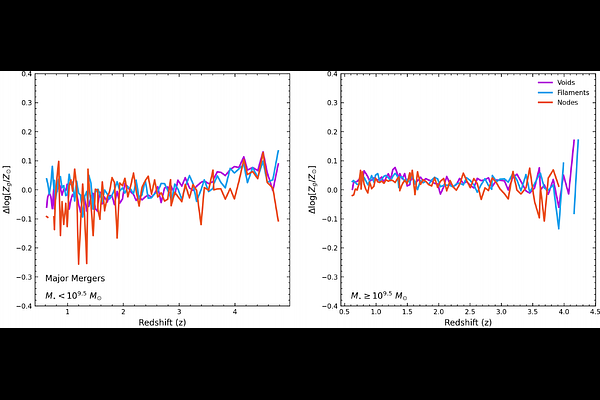
AbstractWe study the impact of supermassive black hole (SMBH) growth, $\langle \dot{M}_\mathrm{SMBH}\rangle$, major and minor galaxy mergers, and gas processes, on the average gas metallicity of galaxies, with the aim to uncover which of these processes drive the scatter in the gas metallicity-stellar mass relation (MZR) at different redshifts in nodes, filaments and voids. At $z=5$, minor mergers produce the largest differential in $\log[Z_g/Z_\odot]$ for all environments, where the node population displays a maximum $0.38$ dex increase in the average $\log[Z_g/Z_\odot]$ compared to non-merging galaxies. The node population also displays a consistent $0.1$ dex reduction in $δ\log[Z_g/Z_{\odot}]$ across all redshifts, whilst filament and void galaxies show a lower magnitude of reduction. Major mergers show little influence on these same properties. This suggests minor mergers regulate metallicity and contribute to over galaxy mass growth concurrently, accelerating chemical evolution post merger. Between $z=1-3$, a high $\langle \dot{M}_\mathrm{SMBH}\rangle$ leads to a reduction in $δ\log[Z_g/Z_{\odot}]$ for all environments. Here, node galaxies show the largest reduction of approximately $0.25$ dex, suggesting that metal-rich outflows strongly drive the MZR at intermediate times. Finally, galaxies with low $M_{gas}/{M_{tot}}$ show increased $δ\log[Z_g/Z_{\odot}]$ across all redshifts and environments, again a $0.25$ dex maximum for node galaxies. These galaxies also spike in $δ\log[Z_g/Z_{\odot}]$ at late times, below $z=1$. At this time, galaxies in the nodes show negative $\langle \dot{M}_\mathrm{gas} \rangle$ whilst also showing the largest $δ\log[Z_g/Z_{\odot}]$ values we observe of $0.2$ dex, suggesting the importance of the balance between gas accretion and starvation in driving MZR scatter at low redshifts.