Gravity Echoes from Supermassive Black Hole Binaries

Gravity Echoes from Supermassive Black Hole Binaries
Qinyuan Zheng, Bence Bécsy, Chiara M. F. Mingarelli
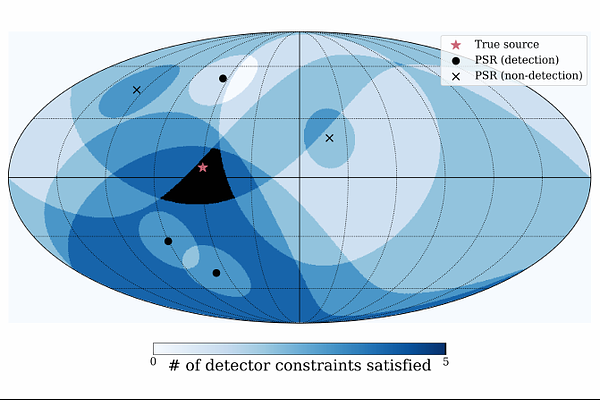
AbstractPulsar timing arrays record gravitational waves from supermassive black hole binaries at two spacetime points: an Earth term, measured when the wave passes the Earth, and a pulsar term, measured when the wave passed each pulsar at an earlier epoch. We show that a future $μ$Hz-band detection of a nearby massive binary by a mission such as $μ$Ares would turn PTA pulsar terms into targeted probes of binary evolution. In analogy with supernova light echoes, each pulsar term acts as a gravity echo: a dated snapshot of the binary at an earlier stage of its inspiral. Together, the $μ$Hz Earth-term measurement and the nHz pulsar-term echoes provide a temporal baseline that neither detector could access alone. For a fiducial equal-mass binary with total mass $10^9\,M_\odot$ at 80~Mpc, we find a combined pulsar timing array echo signal-to-noise ratio of 33, with up to 24 pulsars individually resolving the signal among pulsars with 50-year baselines. The angular dependence of the single-pulsar echo sensitivity alone enables independent sky localization of the source to $\sim$10--100~deg$^2$, and the resolved pulsar-term frequencies directly measure the binary inspiral rate hundreds to thousands of years ago. With sufficient pulsar distance precision, a small set of anchor pulsars could additionally phase-connect the array and trace the post-Newtonian evolution coherently over kpc baselines. The source population required for gravity echoes is drawn from the same massive-end census responsible for the observed nanoHertz stochastic background.