Light, heavy, primordial: exploring the diversity of black hole seeding and growth mechanisms in the JWST era

Light, heavy, primordial: exploring the diversity of black hole seeding and growth mechanisms in the JWST era
Pratika Dayal
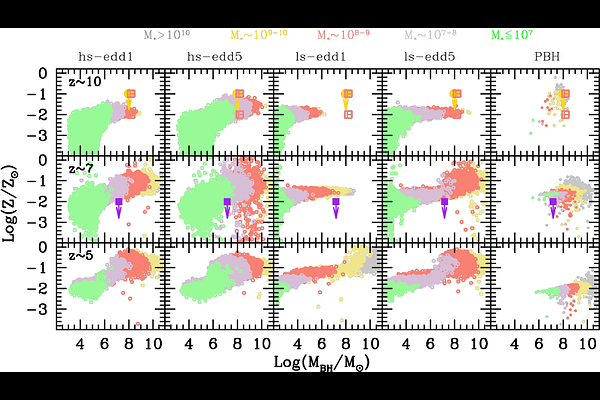
AbstractThe James Webb Space Telescope (JWST) has revealed a puzzling population of massive black holes in the first billion years, many of which are over-massive compared to their hosts (obese black holes), and reside in metal-poor hosts, posing a challenge for theoretical models at these early epochs. In this work, we compare the observational properties of astrophysically-seeded black holes using the DELPHI semi-analytic model and cosmologically-seeded primordial black holes (PBHs) using the PHANES analytic model. We explore the growth of light ($\sim 100 M_\odot$) and heavy ($\sim 10^{3-5}M_\odot$) seeds through mergers and accretion (both Eddington-limited and at super-Eddington rates) in the astrophysical scenario; PBHs (seeded between $10^{0.5-6}M_\odot$) only grow through accretion at sub-Eddington rates. Comparing to observables at $z \sim 5-10$, the only model that can be ruled out is the one where we allow Eddington-limited accretion onto light seeds. The observed high values of the black hole mass-stellar mass relation ($0.3-1$) can be reproduced by both PBHs and heavy seeds accreting at super-Eddington rates. However, only the PBH and Eddington-limited heavy seeding models can simultaneously reproduce the observed black hole masses (${\rm M_{bh}}$), stellar masses ($M_*$), and extremely low host metallicities ($Z \leq 0.01 Z_\odot$) inferred at $z \sim 7-10$. Crucially, we find PBHs show decrease in the black hole mass-stellar mass ratio with increasing halo mass at all redshifts, contrary to any astrophysical black hole model. Selecting systems at $z \sim 7$ with ${\rm M_{bh}}/M_* > 0.1$ and bolometric luminosities $\sim 10^{44-46} {\rm erg~s^{-1}}$ that show a negative black hole to stellar mass ratio and reside in $10^{9-11}M_\odot$ halos offer a promising clustering-based discriminant of PBH seeding models.