A Synchronized Spin Model for Black-Hole Accretion Systems

A Synchronized Spin Model for Black-Hole Accretion Systems
Masahiro Morikawa, Akika Nakamichi
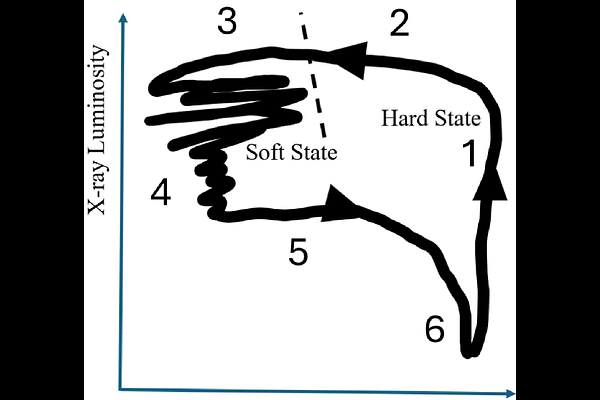
AbstractBlack-hole accretion systems exhibit a characteristic coexistence of activities: broad-band X-ray variability, hot coronae, wide-angle winds, and both steady and discrete jets. This coexistence suggests a persistently time-dependent magnetic background in which noisy fluctuations and explosive release are both essential. In this paper, we connect them all to intermittent magnetic reconnection and propose a Synchronized Spin Model (SSM) in which multiple local dynamos in a rotating accretion flow are represented as interacting macro-spins. Their synchronization, partial synchronization, excursion, and reversal define a compact set of collective variables that organize both timing statistics and large-scale morphology. In this picture, multiscale magnetic reconnection sustains coronal heating, flares, intermittent outflows, and discrete jet activity, while the same synchronization dynamics produce amplitude modulation and demodulation, providing a route to $1/f$-like variability, rms--flux/Taylor-like scaling, and approximately log-normal statistics of the demodulated envelope. We further argue that, although the continuous flux distribution in black-hole systems is more naturally discussed in multiplicative or log-normal terms, broader event-catalog statistics remain useful for describing suitably defined burst hierarchies, particularly by analogy with solar and stellar flare systems. The hard/soft cycle of X-ray binaries is then interpreted as motion through magnetic state space.