XRISM High-Resolution X-ray Spectroscopy of Cygnus X-1 -- highly ionized Iron absorption structures

XRISM High-Resolution X-ray Spectroscopy of Cygnus X-1 -- highly ionized Iron absorption structures
Shinya Yamada, Natalie Hell, Elisa Costantini, Oluwashina Adegoke, McKinley Brumback, Paul Draghis, Ken Ebisawa, Javier A. Garcia, Edmund Hodges-Kluck, Shunji Kitamoto, Shogo Kobayashi, Takayoshi Kohmura, Aya Kubota, Jon M. Miller, Misaki Mizumoto, Tsunefumi Mizuno, Kaito Ninoyu, Hiromitsu Takahashi, Yuusuke Uchida, Kazutaka Yamaoka, Sixuan Zhang
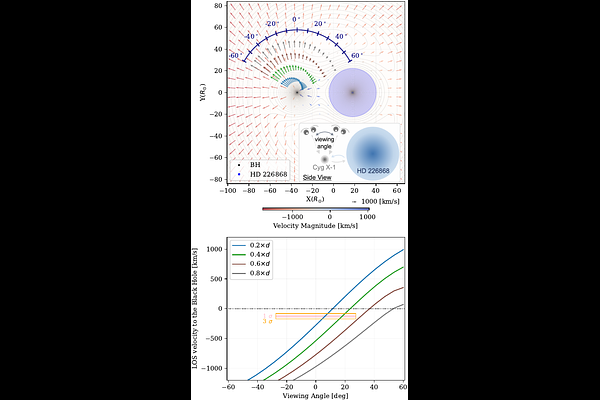
AbstractWe present the first high-resolution X-ray spectral analysis of Cygnus X-1 using XRISM. The observation was carried out from April 7 to 10, 2024, covering the orbital phase range 0.65--0.17 during its low/hard state. Taking advantage of the exceptional energy resolution of the Resolve instrument, we examined highly ionized iron absorption lines and characterized the ionization states, column densities, and line-of-sight velocities of the absorbing plasma. Spectral analysis revealed an ionization parameter of approximately 3, column densities of a few times 10^21 cm^-2, and a blueshifted velocity of approximately 100 km s^-1. The observation was divided into two phases: before and after orbital phase phi_orb = 0.9, corresponding to non-dipping and dipping intervals. While only weak absorption features were present before phi_orb = 0.9, strong absorption by He-like and H-like Fe appeared during the dipping phase. We measured equivalent widths of 2.3 eV, 0.4 eV, and 1.2 eV for He-like Fe K-alpha, and H-like Ly-alpha1 and Ly-alpha2, respectively, demonstrating the capability of XRISM Resolve to securely detect narrow absorption features of only a few eV. These measurements trace the motion of the absorbing material and offer insight into the kinematics and spatial distribution of the wind in the vicinity of the black hole. These findings enhance our understanding of wind-fed accretion in Cygnus X-1 and highlight the importance of continued high-resolution X-ray observations to further constrain the physical properties of winds and accretion flows in high-mass X-ray binaries.