HyQBench: A Benchmark Suite for Hybrid CV-DV Quantum Computing

HyQBench: A Benchmark Suite for Hybrid CV-DV Quantum Computing
Shubdeep Mohapatra, Yuan Liu, Eddy Z. Zhang, Huiyang Zhou
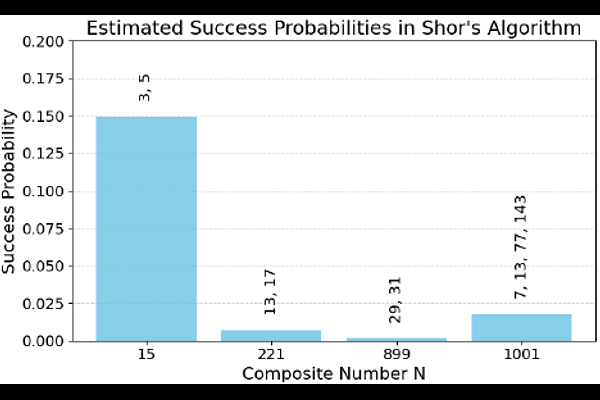
AbstractHybrid continuous-variable (CV)-discrete-variable (DV) quantum systems present a promising direction for quantum computing by combining the high dimensional encoding capabilities of qumodes with the control offered by DV qubits on the coupled qumodes. There have been exciting recent progresses on hybrid CV-DV quantum computing, including variational algorithms, error correction, compiler-level optimizations for Hamiltonian simulation, etc. However, there is a lack of a standardized CV-DV benchmark suite for assessing various emerging hardware platforms and evaluating software optimizations on hybrid CV-DV circuits. In this work, we introduce a simulation and benchmarking framework for hybrid CV-DV circuits, implemented using Bosonic Qiskit-a tool specifically designed to model CV-DV systems, along with QuTip for functional correctness verification. We construct and characterize representative CV-DV benchmarks, including cat state generation, GKP state generation, CV-DV state transfers, hybrid quantum Fourier transform, variational quantum algorithms, Hamiltonian simulation, and Shor's algorithm. To assess circuit complexity and scalability, we define a feature map organized into two categories: general features (e.g., qubit/qumode count, gate counts) and CV-DV-specific features (e.g., Wigner negativity, energy, truncation cost). These metrics enable evaluation of both classical simulability and hardware resource requirements. Our results, including one benchmark on real hardware, demonstrate that hybrid CV-DV architectures are not only viable but well-suited for a range of computational tasks, from optimization to Hamiltonian simulation. This framework lays the groundwork for systematic evaluation and future development of hybrid quantum systems.