Quantifying isochrone-based age uncertainties for rapidly rotating A-type stars

Quantifying isochrone-based age uncertainties for rapidly rotating A-type stars
Simon J. Murphy, Anuj Gautam, Zachary R. Claytor
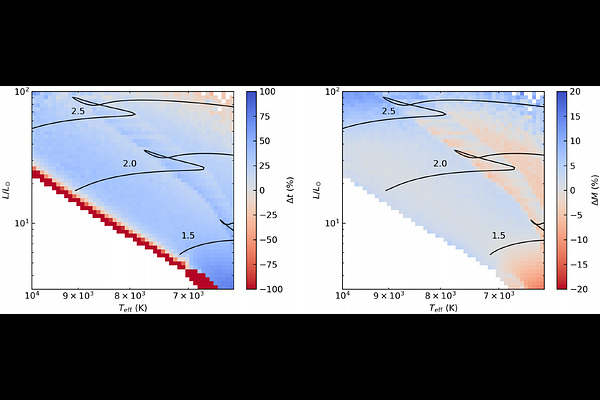
AbstractAccurate stellar ages and masses are essential for interpreting the demographics and physical properties of exoplanets, particularly for intermediate-mass, early-type stars where conventional age indicators are ineffective. Isochrone fitting remains the primary tool for characterising such stars, yet its uncertainties are often underestimated, especially in the presence of rapid rotation and unresolved binarity. We present a population-synthesis framework designed to quantify realistic mass and age uncertainties for intermediate-mass stars (1.4-2.5 M$_{\odot}$), incorporating distributions in rotation rate, mass, metallicity, binarity, inclination, and observational error. Rotational and geometric effects are applied a posteriori to stellar evolutionary models, enabling a continuous treatment of rotation and its impact on effective temperature and luminosity. By comparing synthetic populations against commonly used isochrone grids, we demonstrate that rotation and unresolved companions systematically bias inferred masses and ages, particularly for young stars, and introduce random uncertainties at the $\sim$0.1-M$_{\odot}$ and $\sim$180-Myr level, often exceeding formal fitting errors. The effect is strongest near the zero-age main sequence, where ages are underestimated by a factor of $\geq2$, while for older A stars ($>$10% of their main-sequence lifetime), ages are overestimated by 31% with 27% scatter. Our findings carry important consequences for planet detectability, characterisation, and population studies. We provide a publicly available tool, RAPID, for probabilistic inference of stellar parameters from these synthetic populations, and we demonstrate its application to known exoplanet hosts.