A Dual-Helix Governance Approach Towards Reliable Agentic AI for WebGIS Development

A Dual-Helix Governance Approach Towards Reliable Agentic AI for WebGIS Development
Boyuan, Guan, Wencong Cui, Levente Juhasz
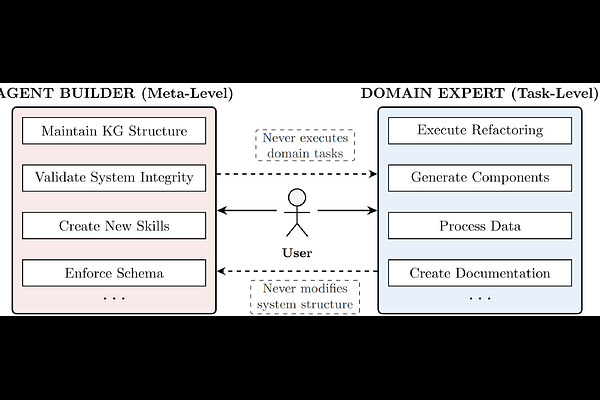
AbstractWebGIS development requires rigor, yet agentic AI frequently fails due to five large language model (LLM) limitations: context constraints, cross-session forgetting, stochasticity, instruction failure, and adaptation rigidity. We propose a dual-helix governance framework reframing these challenges as structural governance problems that model capacity alone cannot resolve. We implement the framework as a 3-track architecture (Knowledge, Behavior, Skills) that uses a knowledge graph substrate to stabilize execution by externalizing domain facts and enforcing executable protocols, complemented by a self-learning cycle for autonomous knowledge growth. Applying this to the FutureShorelines WebGIS tool, a governed agent refactored a 2,265-line monolithic codebase into modular ES6 components. Results demonstrated a 51\% reduction in cyclomatic complexity and a 7-point increase in maintainability index. A comparative experiment against a zero-shot LLM confirms that externalized governance, not just model capability, drives operational reliability in geospatial engineering. This approach is implemented in the open-source AgentLoom governance toolkit.