Spectro-timing origin of large amplitude X-ray variability in GRS 1915+105 using AstroSat/LAXPC and SXT

Spectro-timing origin of large amplitude X-ray variability in GRS 1915+105 using AstroSat/LAXPC and SXT
Shree Suman IIT Hyderabad, Shuvajit Khatua RRI Bangalore, Vishal Jadoliya IIT Hyderabad, Prathamesh Narayan Gupta DTU New Delhi, Mayukh Pahari IIT Hyderabad
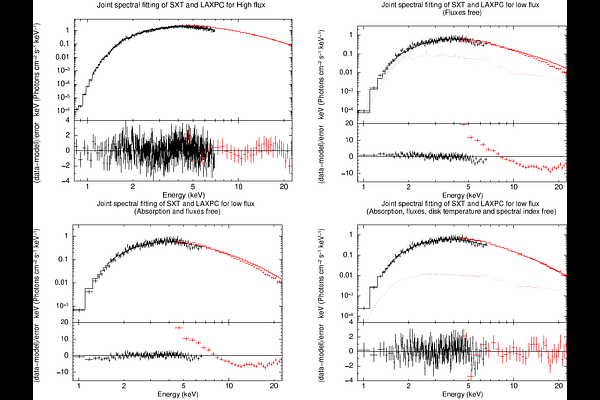
AbstractThe origin of the large-amplitude, quasi-periodic X-ray flux variations in several classes of the Galactic microquasar GRS~1915+105 remains unresolved. We address this issue through flux-resolved, broadband (0.8-20 keV) spectral modelling and simultaneous covariance spectral analysis during two $κ$ and two $ω$ class observations using \textit{AstroSat}/SXT and LAXPC. The lightcurves show strong, quasi-periodic oscillations involving rapid transitions between bright bursts and deep dips on timescales of a few tens of seconds. Flux-resolved spectroscopy indicates that high-flux intervals in both classes are dominated by a hot, optically thick accretion disc with steep Comptonized emission, whereas low-flux intervals correspond to a cooler or partially recessed disc and a harder coronal continuum. These transitions involve a systematic 1-2 keV drop in disc temperature and a pronounced hardening of the Comptonized component, with flux reductions of up to a factor of five. Using covariance spectra across 0.015-5 Hz, we show that the rapid coherent variability arises almost entirely from the disc, which exhibits strong energy-dependent variations, while the Comptonized component contributes minimally. The combined results suggest that radiation-pressure-driven structural changes in the disc, with a slower coronal response, produce the observed oscillations, consistent with cyclic disc evacuation and refilling in the $κ$ and $ω$ classes.