Early Multiwavelength Observations of AT 2026fgk: The Luminous Afterglow to Sub-luminous GRB 260310A, Identified Independently of a Gamma-ray Trigger

Early Multiwavelength Observations of AT 2026fgk: The Luminous Afterglow to Sub-luminous GRB 260310A, Identified Independently of a Gamma-ray Trigger
K. -R. Hinds, A. Y. Q. Ho, Y. Wagh, R. Jayaraman, D. A. Perley, G. Waratkar, A. Bochenek, B. P. Gompertz, C. Fremling, J. Rastinejad, N. Sarin, G. Schroeder, R. A. Perley, G. P. Srinivasaragavan, K. Ackley, T. Ahumada, M. F. Aller, I. Andreoni, A. Aryan, S. Belkin, E. C. Bellm, S. Ben-Ami, T. de Boer, M. Bremer, R. P. Breton, S. B. Cenko, K. C. Chambers, T. -W. Chen, C. T. Christy, G. Corcoran, L. Cotter, M. W. Coughlin, F. Cuadra, V. D'Elia, K. De, V. S. Dhillon, Dimple, M. J. Dyer, A. R. Escorial, D. K. Galloway, S. Garrappa, J. H. Gillanders, M. A. Gurwell, X. J. Hall, M. E. Huber, S. Ibrahim, J. C. Jaimes, P. Jakobsson, E. Kammoun, M. Kasliwal, G. K. Keating, T. Killestein, R. Konno, R. Kotak, D. Kovaleva, A. Krassilchtchikov, A. Kraus, A. Kumar, R. R. Laher, A. Levan, J. Lyman, A. Martin-Carrillo, Z. McGrath, P. Minguez, G. Mo, M. Nicholl, K. Noysena, A. Nugent, L. K. Nuttall, P. O'Brien, D. O'Neill, E. O. Ofek, G. S. H. Paek, P. V. de la Parra, D. Polishook, A. Ruiz Del Pozo, G. Pugliese, J. Purdum, M. Pursiainen, G. Ramsay, R. Rao, A. C. Readhead, P. Rekhi, R. Riddle, S. Rose, B. Rusholme, A. Sasli, D. Schiminovich, E. Segre, C. Sevilla, Y. M. Shani, M. Shrestha, S. J. Smartt, K. W. Smith, J. Sollerman, N. Sravan, S. Srivastav, D. Steeghs, R. Stein, T. Surti, K. Ulaczyk, J. C. Vel'azquez, R. Wainscoat, J. L. Wise, D. Xu, S. Yang
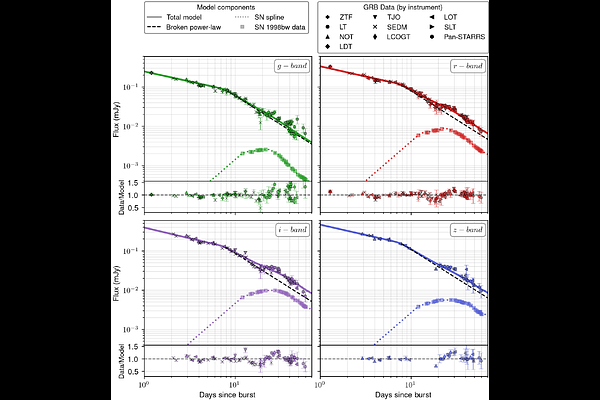
AbstractThe origins of sub-luminous ($L_\mathrm{γ,\mathrm{iso}} < 10^{49.5}$\,erg\,s$^{-1}$) gamma-ray bursts (GRBs) associated with broad-lined Type~Ic supernovae (Ic-BL SNe) are poorly understood, in part due to the low discovery rate and faint afterglows. Here we present the identification of the optical afterglow of Fermi-GBM-detected GRB\,260310A (AT\,2026fgk) as a rapidly rising ($>1\,$mag\,d$^{-1}$), red ($g-r=0.4$\,mag) transient using the Gravitational-wave Optical Transient Observatory, Large Array Survey Telescope, and Zwicky Transient Facility (ZTF) data streams. We present multiwavelength follow-up observations from the first 50\,days, which reveal that GRB 260310A/AT\,2026fgk was sub-luminous ($L_\mathrm{γ,iso}=10^{48.8}\,$erg\,s$^{-1}$); it was the most nearby ($z=0.153$) afterglow identified blindly by an optical survey; and that it is one of the brightest afterglows ever observed at X-ray, optical, and radio (cm to mm) wavelengths. We spectroscopically confirm an underlying Ic-BL SN with properties typical of GRB-SNe ($M_\mathrm{ej}\approx3\,M_\odot$, $E_{\rm K}\approx 10^{52}\,$erg). With basic modeling of the afterglow, including the long optical rise ($\approx10^{3}\,$s), we infer either a low initial Lorentz factor ($Γ_0\approx40$) or a slightly off-axis viewing angle ($\lesssim3^\circ$). The host galaxy's mass and star formation rate are similar to the hosts of other sub-luminous GRBs. ZTF's flux-limited survey gives a volumetric rate of AT\,2026fgk-like events of $0.30^{+1.37}_{-0.29}\,$Gpc\,$^{-3}$\,yr$^{-1}$, which is consistent with the on-axis, high luminosity ($L_{\rm γ,iso}>10^{49.5}$\,erg\,s$^{-1}$) long-GRB rate. The similarity in the rates strongly constrains the prevalence of low-$Γ_0$ bursts and the beaming of the initial relativistic material in GRBs.