Joint Estimation of Properties of the Lunar Subsurface and Galactic Foregrounds with LuSEE-Night

Joint Estimation of Properties of the Lunar Subsurface and Galactic Foregrounds with LuSEE-Night
Fatima Yousuf, Zack Li, Stuart D. Bale, David W. Barker, Jack Burns, Christian H. Bye, Hugo Camacho, Cristina-Maria Cordun, Johnny Dorigo Jones, Adam Fahs, Sonia Ghosh, Keith Goetz, Robert Grimm, Sven Herrmann, Joshua J. Hibbard, Oliver Jeong, Marc Klein-Wolt, Léon V. E. Koopmans, Joel Krajewski, Corentin Louis, Milan Maksimović, Ryan McLean, Raul A. Monsalve, Arnur Nigmetov, Paul O'Connor, Aaron Parsons, Michel Piat, Marc Pulupa, Rugved Pund, David Rapetti, Kaja M. Rotermund, Benjamin Saliwanchik, Anže Slosar, Graham Speedie, Nikolai Stefanov, David Sundkvist, Aritoki Suzuki, Harish K. Vedantham, Philippe Zarka
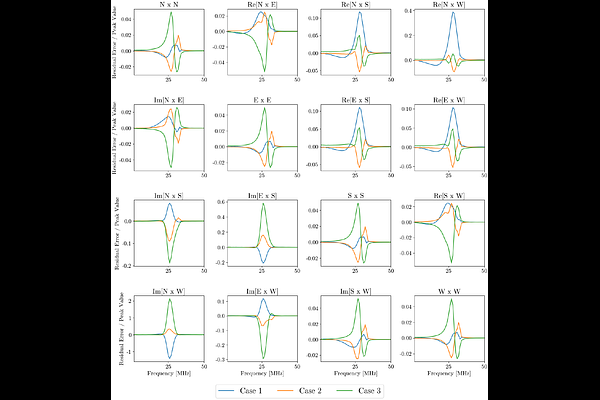
AbstractThe Lunar Surface Electromagnetics Experiment (LuSEE-Night) is a joint NASA-DOE-ESA low-frequency radio telescope that will reach the lunar far side in 2027. The unknown dielectric properties of the subsurface at the LuSEE-Night landing site impose the most significant limitation for precision instrument calibration, as reflections from the lunar subsurface can change the primary beam at the 10-20% level. Simulations of these effects have provided insight and concern, showing that the lunar subsurface modeled as a lossy dielectric can absorb a large amount of the power of the sky signal. While this absorption may not strongly impact the signal-to-noise ratio in a sky-noise-dominated regime, it could complicate the beam pattern and make the signal more difficult to model and interpret. We have simulated the far-field properties of the LuSEE-Night beam for varying dielectric profiles of the lunar subsurface. We find that varying the properties of the lunar subsurface has the most significant impact around the antenna resonance, impacting its amplitude, position and width. Conversely, changing the properties of the foreground impacts the data across the band. We use a Bayesian inference pipeline to jointly estimate parameters of a galactic foreground model and dielectric properties of the lunar subsurface around the LuSEE-Night landing site and find that parameters of both the galaxy and subsurface properties can be estimated jointly. While the modeling is somewhat idealized, we believe that the results are largely robust owing to the fact that spectral variations for plausible subsurface and galaxy models have very different spectral signatures.