Deep Learning with Magnetic Parameter Constraints for Short-Term Prediction of Solar Active Region Vector Magnetic Fields

Deep Learning with Magnetic Parameter Constraints for Short-Term Prediction of Solar Active Region Vector Magnetic Fields
Yuqing Zhou, Hui Liu, Zhenyu Jin, Yuyang Li, Sizhong Zou, Jiaben Lin, Mingfu Shao, Zhuoheng Huang
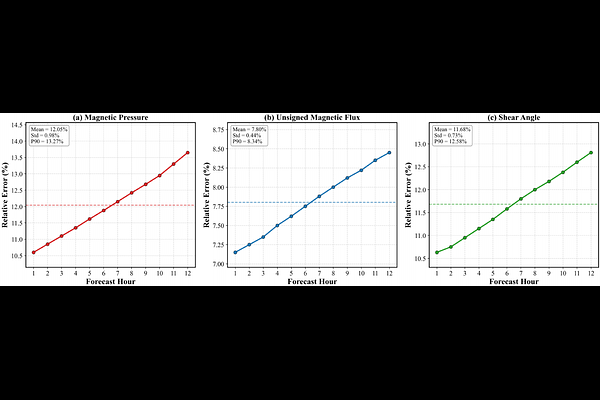
AbstractForecasting the dynamic evolution of solar magnetic fields is a critical technique for enabling space weather warnings. Addressing the limitations of existing methods in predicting all vector magnetic field components and in maintaining consistency with solar surface magnetic-field-related quantities, this study proposes a deep learning prediction method that integrates dynamic masks of active regions with multiple magnetic parameter constraints. By constructing a three-channel representation of vector magnetic fields, applying dynamic masks to enhance attention to strong-field regions, and incorporating multi-parameter magnetic parameter constraints, we developed an end-to-end short-term (12-hour) predictive model of solar vector magnetic field evolution. Using SDO/SHARP vector magnetogram data, the model predicts and analyses field evolution across all components. Quantitative evaluations demonstrate that our approach achieves horizon-averaged structural similarity index measure (SSIM) of 0.912 (per-hour range: 0.909--0.916) and correlation coefficient (CC) of 0.998 for the radial component Br (root-mean-square error (RMSE) 13.0--21.0 G); the horizontal components achieve Bphi SSIM 0.760--0.800 (CC 0.910--0.945, RMSE 38.5--50.0 G) and Btheta SSIM 0.728--0.750 (CC 0.895--0.920, RMSE 38.5--49.0 G). The model maintains unsigned magnetic flux prediction errors at 7.82% (95% confidence interval (CI): +/-0.11%). These results demonstrate strong image-domain performance together with consistency under the magnetic-parameter diagnostics used here, suggesting initial potential for supporting future space weather forecasting efforts.