Magnetar Engines in Broad-lined Type Ic Supernovae and a Unified Picture for Magnetar-powered Stripped-envelope Supernovae

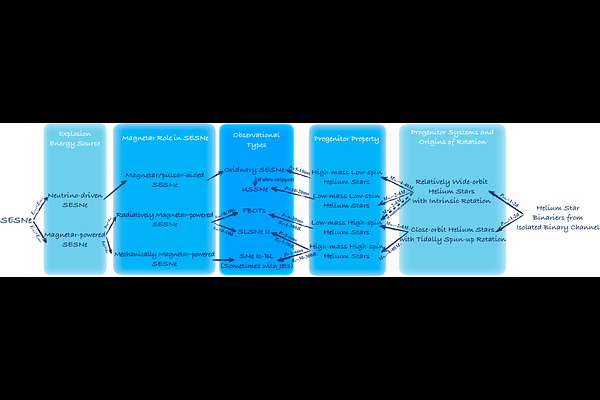
Magnetar Engines in Broad-lined Type Ic Supernovae and a Unified Picture for Magnetar-powered Stripped-envelope Supernovae
Jin-Ping Zhu, Bing Zhang
AbstractWe model the multi-band lightcurves of 80 SNe Ic-BL, including 11 associated with lGRBs, using a magnetar engine model with $^{56}$Ni decay. We find that the data are all consistent with a magnetar central engine, and such a model yields high-quality fits across the sample. The medians with $1σ$ regions of the key parameters are $P_{\rm{i}}\sim2.04^{+1.84}_{-0.96}\,{\rm{ms}}$, $B_{\rm{p}}\sim3.96^{+3.28}_{-1.40}\times10^{15}\,{\rm{G}}$, $M_{\rm{ej}}\sim2.30^{+1.48}_{-1.02}\,M_\odot$, and $M_{\rm{Ni}}\sim0.18^{+0.14}_{-0.09}\,M_\odot$, with strong and statistically significant correlations observed for both $M_{\rm{ej}}-P_{\rm{i}}$ (anti-correlation) and $M_{\rm{Ni}}-M_{\rm{ej}}$ (correlation). Comparing the SN Ic-BL samples with and without lGRB association using fitting parameters, we find no significant difference between them, although the GRB-associated sample is slightly brighter, possibly due to an observational bias. Relative to ordinary SNe Ic, SNe Ic-BL have similar $^{56}$Ni and ejecta masses, suggesting comparable pre-SN progenitor properties, with differences possibly arising from the presence of a magnetar engine. In comparison with other possible magnetar-powered SESNe, including SLSNe Ic and FBOTs, we confirm a strong universal $M_{\rm{ej}}-P_{\rm{i}}$ correlation, indicating a common origin. SNe Ic-BL and SLSNe Ic have similar ejecta mass distributions, typically $M_{\rm ej}\gtrsim0.5\,M_\odot$, while FBOTs mostly lie below this value. Differences between SNe Ic-BL and SLSNe Ic may arise from magnetar properties, with SN Ic-BL magnetars rotating faster and having stronger fields. Moreover, the $P_{\rm{i}}-B_{\rm{p}}$ distribution of lGRB magnetars largely overlaps with that of SN Ic-BL magnetars. In connection with binary simulation results, we propose a unified physical classification and progenitor framework for magnetar-powered and ordinary SESNe.