Web-Halo Model Peak-Background Split (WHM-PBS): halo bias as a distribution, not a number

Web-Halo Model Peak-Background Split (WHM-PBS): halo bias as a distribution, not a number
Samuel Brieden, Alexander Tipp
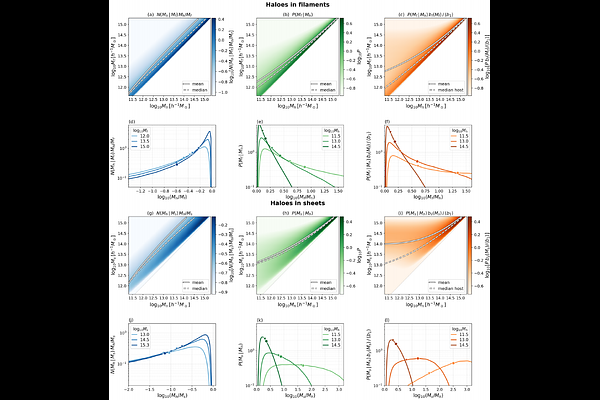
AbstractWe present the Web--Halo Model Peak--Background Split (WHM-PBS), an analytic theory in which the large-scale bias of a dark-matter halo is inherited from its cosmic-web environment. Building on the Web--Halo Model, we use the Shen \textit{et al.} moving barriers for ellipsoidal collapse generating the web hierarchy in which every halo sits inside a host filament, itself inside a sheet. Combined with the peak--background split, this picture replaces the deterministic bias--mass relation $b(M_h)$ with the bias of the host environment, averaged over the conditional mass function. As a result, halo bias $b(M_h)$ is no longer a number but a strongly skewed \emph{distribution}. In this work we make use of this distribution in three different ways: as (i) a physically motivated prior on bias relations, (ii) a prediction on halo stochasticity, and (iii) a framework for assembly bias models. Regarding (i) we find that the density bias relations $b_2(b_1)$ and $b_3(b_1)$ stay tight, while the tidal bias $b_{s^2}(b_1)$ shows significant scatter, as found in $N$-body simulations. Regarding (ii), once including halo exclusion, our model reproduces the super- to sub-Poisson shot-noise trend of Baldauf \textit{et al.} which we convert into a prior band on the EFT stochasticity amplitude parameters. Finally, regarding (iii) in the density sector it explains the bias--concentration--correlation inversion of Paranjape \textit{et al.} at the characteristic mass ($M_\mathrm{h}\simeq1.7\times10^{13}\,h^{-1}\Msun$), with no parameter tuned to assembly bias.