A Framework for Linking Pre- and Post-Common Envelope Binary Properties with Star Clusters: The First Demonstration with a Massive White Dwarf+M Dwarf Binary in Alessi 12

A Framework for Linking Pre- and Post-Common Envelope Binary Properties with Star Clusters: The First Demonstration with a Massive White Dwarf+M Dwarf Binary in Alessi 12
Steffani M. Grondin, Maria R. Drout, Jason Nordhaus, Philip S. Muirhead, Bailey Filer, Alexander Laroche, Jeremy J. Webb, Floor S. Broekgaarden, Ryan Chornock, Kyle Kremer, Natalie LeBaron, Raffaella Margutti, Nikki Noughani, Huei Sears, Pier-Emmanuel Tremblay
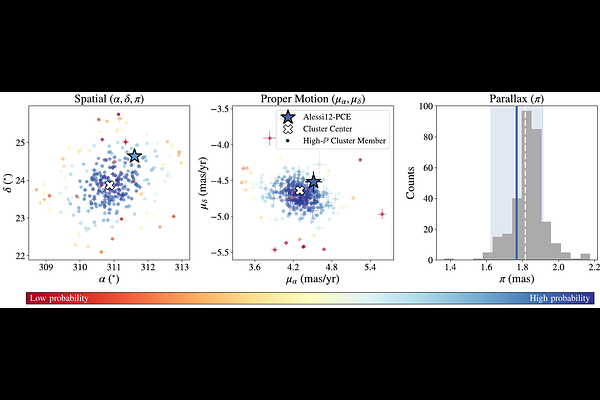
AbstractCommon envelope (CE) evolution is a critical phase in the lives of binary stars, producing close binaries that are progenitors of type Ia supernovae and gravitational wave sources. Despite its importance, CE evolution remains poorly understood, largely due to the scarcity of systems with constrained pre- and post-CE properties. Here, we present a star cluster-based framework for reconstructing the evolutionary histories of white dwarf+main-sequence (WD+MS) post-CE binaries, where cluster membership can provide an independent age constraint and/or rule out a merger origin for the WD. We demonstrate this method with Alessi12-PCE, the first such binary in an open cluster with precisely determined pre- and post-CE properties. We classify the companion as an M4V and measure a WD mass of $1.06 \pm 0.02 M_{\odot}$, making it the most massive WD+MS binary associated with a cluster. A 6.99-hour periodicity detected in a light curve is confirmed as the binary orbital period via radial velocity monitoring. Combined with the WD mass, WD cooling age, and Alessi 12 cluster age, stellar evolution models imply a $5.40 \pm 0.10 M_{\odot}$ WD progenitor that entered a CE on the asymptotic giant branch (AGB). CE evolution models where convection is the dominant physical mechanism that sets $α_{\text{CE}}$ reproduce the observed orbital separation in exactly two scenarios: either a mid-AGB interaction with $α_{\text{CE}}\approx0.99$, or a late-AGB interaction with $α_{\text{CE}}\approx0.05$. Applicable to other post-CE binaries in star clusters, our new framework enables empirical constraints on CE physics inaccessible from field binaries alone.