Spectrally Corrected Polynomial Approximation for Quantum Singular Value Transformation

Spectrally Corrected Polynomial Approximation for Quantum Singular Value Transformation
Krishnan Suresh
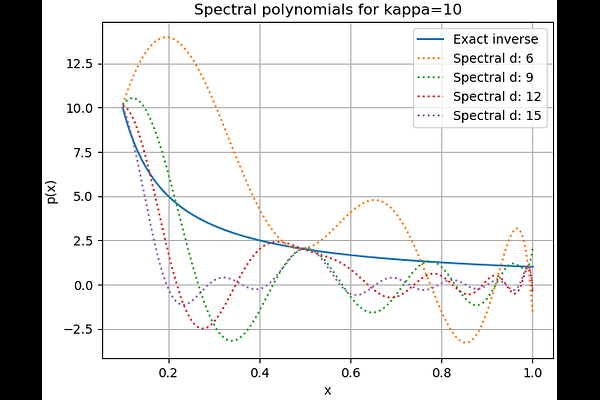
AbstractQuantum Singular Value Transformation (QSVT) provides a unified framework for applying polynomial functions to the singular values of a block-encoded matrix. QSVT prepares a state proportional to $\bA^{-1}\bb$ with circuit depth $O(d\cdot\mathrm{polylog}(N))$, where $d$ is the polynomial degree of the $1/x$ approximation and $N$ is the size of $\bA$. Current polynomial approximation methods are over the continuous interval $[a,1]$, giving $d = O(\sqrt{\kap}\log(1/\varepsilon))$, and make no use of any properties of $\bA$. We observe here that QSVT solution accuracy depends only on the polynomial accuracy at the eigenvalues of $\bA$. When all $N$ eigenvalues are known exactly, a pure spectral polynomial $p_{S}$ can interpolate $1/x$ at these eigenvalues and achieve unit fidelity at reduced degree. But its practical applicability is limited. To address this, we propose a spectral correction that exploits prior knowledge of $K$ eigenvalues of $\bA$. Given any base polynomial $p_0$, such as Remez, of degree $d_0$, a $K\times K$ linear system enforces exact interpolation of $1/x$ only at these $K$ eigenvalues without increasing $d_0$. The spectrally corrected polynomial $p_{SC}$ preserves the continuous error profile between eigenvalues and inherits the parity of $p_0$. QSVT experiments on the 1D Poisson equation demonstrate up to a $5\times$ reduction in circuit depth relative to the base polynomial, at unit fidelity and improved compliance error. The correction is agnostic to the choice of base polynomial and robust to eigenvalue perturbations up to $10\%$ relative error. Extension to the 2D Poisson equation suggests that correcting a small fraction of the spectrum may suffice to achieve fidelity above $0.999$.