Magnetohydrodynamical opening of dust traps in protoplanetary disks

Magnetohydrodynamical opening of dust traps in protoplanetary disks
Sergey Khaibrakhmanov, Vitaly Akimkin
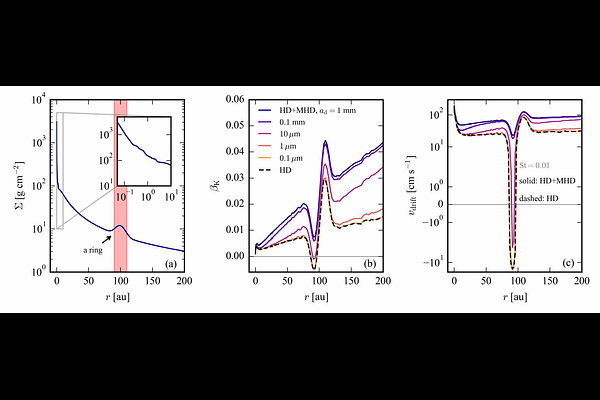
AbstractObserved ring-like structures in protoplanetary disks are often interpreted as local pressure maxima, which induce efficient dust concentration. We revisit this paradigm, considering the effect of the large-scale magnetic field stresses on the gas rotation speed. Our simulations show that the magnetic field can be dynamically strong and cause $1-2$% deviation from the Keplerian rotation at the periphery of a typical turbulent disk with dust grains of size $> 1\,μ$m. This effect increases the inward drift speed of large grains characterized by Stokes number of $0.01-0.1$ by up to two times in our simulations. Importantly, such MHD deviation from the Keplerian rotation does not depend on the local gas pressure gradient and leads to drift towards the star only. The fast drift induced by this effect can cancel out the outward drift caused by the positive pressure gradient at the inner edge of a ring and open up the dust trap. For the disks with turbulence parameter $α=10^{-3}$, this effect appears in the rings with a half-width of $10$ au and a density contrast up to $60$% ($200$% for $α=10^{-2}$). Thus, the presence of a large-scale magnetic field in protoplanetary disks either completely prevents or imposes stricter conditions for dust accumulation and the onset of the streaming instability in the density rings in protoplanetary disks.