Efficient Classical Simulation of Heuristic Peaked Quantum Circuits

Efficient Classical Simulation of Heuristic Peaked Quantum Circuits
David Kremer, Nicolas Dupuis
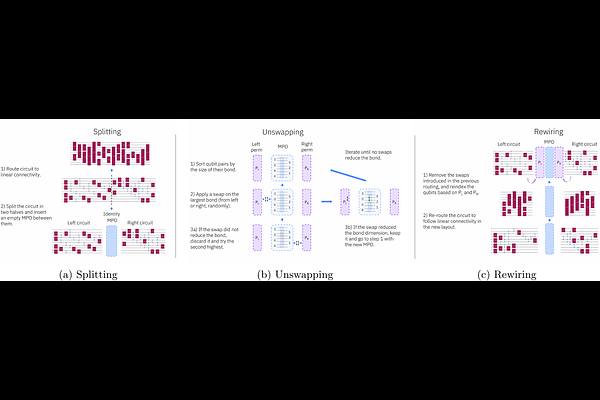
AbstractPeaked quantum circuits, whose output distribution is sharply concentrated on a single bitstring, have emerged as a promising candidate for verifiable quantum advantage, as the correctness of the quantum output can be checked by simply comparing against the known peak. Recent work by Gharibyan et al. arXiv:2510.25838 claimed heuristic quantum advantage using peaked circuits executed on Quantinuum's 56-qubit H2 processor. These peaked circuits concentrate their output on a single hidden bitstring by training a shallow simulable circuit variationally and inserting an obfuscated permutation to increase the depth to a level that makes classical simulation intractable, with estimated runtimes of years for the largest instances. We show that these circuits can be efficiently simulated classically. We describe a method that efficiently performs a full tensor network contraction, allowing near-exact sampling and extraction of the peaked bitstring. The method exploits the mirrored structure of the circuit and iteratively cancels both halves into a Matrix Product Operator (MPO), and avoids the obfuscated permutation by greedily reducing the MPO bond dimension through a process we call unswapping. The method can fully contract and extract the peak of the largest circuit in approximately one hour on a single GPU, around half the time it took to run on the quantum hardware.