On The Nature of Einstein Probe Transient EP250916a: Insights from X-ray, Optical, and Radio Observations

On The Nature of Einstein Probe Transient EP250916a: Insights from X-ray, Optical, and Radio Observations
Gaurava K. Jaisawal, Giulia Illiano, Francesco Carotenuto, Astrid L. Bouquin, David M. Russell, Giorgos Leloudas, Andrea Sanna, Dalya Akl, Rob Fender, Sara Motta
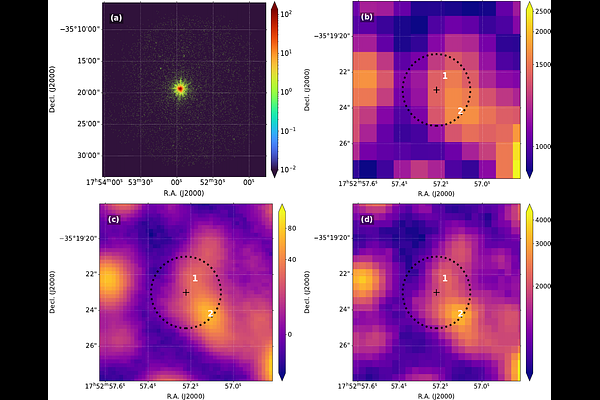
AbstractWe report multi-wavelength studies of the transient EP250916a, detected by the Einstein Probe on 2025 September 16. Located at low Galactic latitude, the source exhibited a rapid X-ray brightening, reaching an unabsorbed 0.5--10 keV flux of $(6.4 \pm 0.1) \times 10^{-10}$ erg cm$^{-2}$ s$^{-1}$, followed by a plateau and a two-stage decay lasting over 40 days. Swift/XRT monitoring shows a persistently hard spectrum ($Γ\approx 1.6$--2.2) with only modest softening during decay, while a NuSTAR observation confirms a hard-state continuum extending up to 70 keV. Timing analysis of XMM-Newton data reveals a weak quasi-periodic oscillation (QPO) at $\sim$13 Hz. No other coherent pulsations or thermonuclear bursts are detected. Broadband spectral modeling favors a nonthermal power-law continuum with partial-covering absorption, and shows no significant thermal disk component. Optical imaging obtained with NOT/ALFOSC, LCO, and GaiaDR3 identifies two faint sources within the 2 arcsec Swift/XRT positional uncertainty. A MeerKAT observation at 1.28 GHz yielded no radio counterpart, with a 3$σ$ upper limit of 60 $μ$Jy beam$^{-1}$. The combination of a long-lasting outburst, a hard nonthermal X-ray spectrum, a weak QPO detection, the absence of coherent timing features, and faint potential optical counterparts disfavors a stellar-flare or extragalactic origin and supports an accreting compact-object scenario. Comparisons with similar faint, hard-state transients place EP250916a within a growing population of low-luminosity, hard-state black hole X-ray binary candidates.