Toward Inferring the Surface Fluxes of Biosignature Gases on Rocky Exoplanets from Telescope Spectra

Toward Inferring the Surface Fluxes of Biosignature Gases on Rocky Exoplanets from Telescope Spectra
Nicholas F. Wogan, Natasha E. Batalha, Joshua Krissansen-Totton, Kevin Zahnle, Victoria S. Meadows, Amber V. Young, Evan L. Sneed, Edward W. Schwieterman
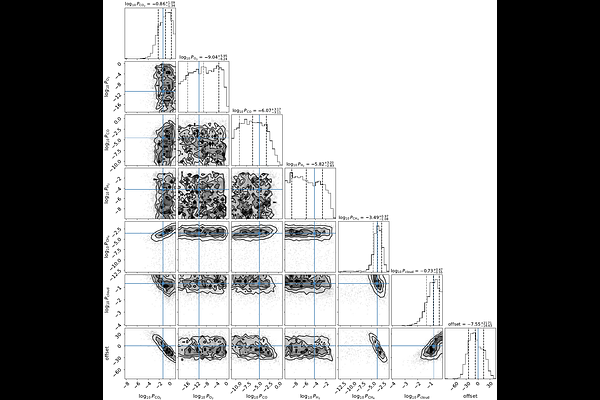
AbstractThe James Webb Space Telescope and the future Habitable Worlds Observatory aim to discover exoplanet atmospheric spectra that detect life. Currently, most existing spectral "retrieval" algorithms focus on inferring the abundances of biogenic gases from these spectra. However, abundances are hard to interpret as signatures of life because they are modified by photochemistry, climate, and atmospheric escape. To address this problem, we develop a method for inferring the fluxes of gases at a planetary surface by inverting a coupled photochemical-climate model. As a proof-of-concept, we apply the approach to a synthetic 10-transit JWST NIRSpec Prism spectrum of TRAPPIST-1 e assuming it hosts a biosphere similar to the Archean Earth's. The retrieval confidently detects CO$_2$ and CH$_4$ and can constrain the flux of CH$_4$ into the atmosphere to within approximately 1.5 orders of magnitude (68$\%$ credible interval) provided that TRAPPIST-1's near-UV spectrum is accurately known. We demonstrate how inferred surface gas fluxes naturally fold into a probabilistic assessment of life, finding that ~ 80$\%$ of the surface gas flux posterior is consistent with a CH$_4$-producing metabolism for our nominal test case. As with any inverse problem, these results are conditional on a number of assumptions in our forward model. Overall, we argue that increasing the robustness of life detection on exoplanets requires moving beyond atmospheric abundances toward inference of the surface fluxes that sustain them.