On the Relationship between Solar Spicules and Propagating Coronal Disturbances: The Role of Shocks

On the Relationship between Solar Spicules and Propagating Coronal Disturbances: The Role of Shocks
Ravi Chaurasiya, Sankalp Srivastava, Piyali Chatterjee, Sahel Dey, Robertus Erdélyi, Ankala Raja Bayanna
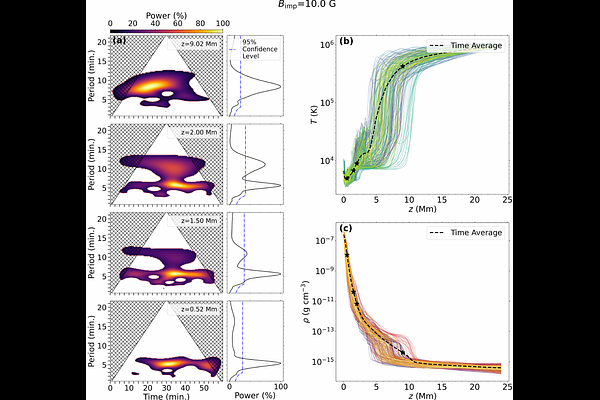
AbstractSpicules and propagating coronal disturbances (PCDs) are ubiquitous dynamic features of the solar atmosphere, yet their physical connection remains an open question of paramount importance to the mass and energy transport in the solar atmosphere. Using concurrent multiwavelength high-resolution observations from the Swedish 1-m Solar Telescope and the Solar Dynamics Observatory, supported with two-dimensional radiative magnetohydrodynamic (MHD) simulations, we find that i) shock waves in the chromosphere generated from non-linear wave steepening drive some spicules, ii) in the corona, these shock waves may transition into large amplitude non-linear compressive MHD waves depending on the magnetic field strength and the ambient coronal conditions. In either case, the shocks or the large-amplitude compressive waves in the corona, also transport upward mass flux and produce intensity variations in the form of PCDs in coronal passbands. Further a multi-height wavelet analysis shows dominant $\sim$5 minute periods in the lower chromosphere that evolve into longer periods ($\ge$10 minutes) at higher atmospheric layers, consistent with dispersive propagation in a stratified medium. The observational characteristics together with the numerical simulations, demonstrate that a shock-driven MHD mechanism links spicule formation to coronal disturbances. Finally, mass flux estimates from both the observations and the simulations indicate that these PCDs can also aid in supplying mass to the solar wind.