A Unified Ionization Framework for the Spectroscopic Diversity of Tidal Disruption Events

A Unified Ionization Framework for the Spectroscopic Diversity of Tidal Disruption Events
Lars L. Thomsen, Lixin Dai, Daniel Kasen, Enrico Ramirez-Ruiz, Panos Charalampopoulos, Giorgos Leloudas, Brenna Mockler
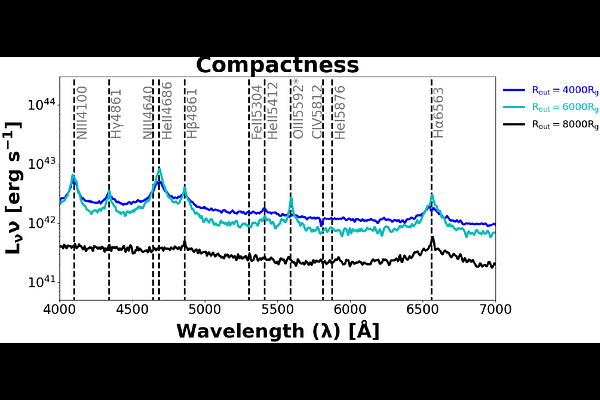
AbstractOptical tidal disruption events (TDEs) exhibit extremely broad emission lines ($\approx 10^3$-$10^4~{\rm km~s^{-1}}$) and are observationally classified into four spectroscopic types: H-dominated, He-dominated, H+He, and featureless. The prevalent H+He class often displays Bowen fluorescence lines (notably \niii~and \oiii), features that are rarely observed in active galactic nuclei and whose origin has remained poorly understood. We present the first unified radiative transfer framework that reproduces all four TDE spectroscopic classes using simulations of optically thick, outflowing envelopes with solar composition. Our models successfully capture both the continuum properties and key spectral features, including strong \ha, \heii~and Bowen emissions. We demonstrate that the spectroscopic diversity of TDEs is primarily governed by the gas ionization state, controlled by the ratio of injected luminosity to envelope mass. As the ionization level decreases, the observed sequence of spectroscopic classes emerges naturally, transitioning from featureless to He-dominated, to Bowen-dominated, and finally to H-dominated spectra. We further show that electron scattering in the optically thick outflow is the dominant mechanism responsible for the extreme line widths, linking line profiles directly to the physical properties of the wind. The model also explains the observed correlations with luminosity, black hole mass, and the relative stability of spectral classifications during TDE evolution. This work establishes a unified physical framework for TDE spectroscopy, providing new insight into the emission mechanisms, energetics, and outflow structure of these transient events, and offering a practical pathway for interpreting and fitting observed spectra.