When galaxies burst II. Implications of enhanced burstiness for the 21-cm Cosmic Dawn signal

When galaxies burst II. Implications of enhanced burstiness for the 21-cm Cosmic Dawn signal
Hovav Lazare, Sarah Libanore, Eleonora Vanzan, Julian B. Muñoz, Ely D. Kovetz
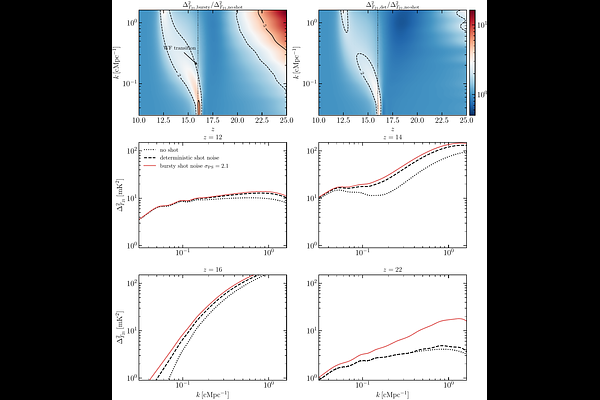
AbstractRecent JWST observations suggest that star formation in the early universe was substantially burstier than assumed in standard models. Such burstiness can be described as a stochastic process characterized by the burst amplitude and the coherence time of star formation epochs. In this paper, we investigate how bursty star formation modifies the 21-cm power spectrum during Cosmic Dawn through its impact on the non-local radiation fields that govern its evolution, namely Lyman-$α$ and X-ray backgrounds. To do so, we introduce an unequal-time correlation in the star-formation-rate density sourcing the two fields and we compute its impact using the analytical framework implemented in the public code Zeus21. We find that the burstiness-induced time correlation produces a shot-noise-like contribution in the Lyman-$α$ and X-ray fields, enhancing both their auto- and cross-power spectra while leaving the global 21-cm signal, $T_{21}(z)$, unchanged. As a result, the 21-cm power spectrum is strongly modified by a shot-noise-like contribution at the beginning of the Cosmic Dawn, where the signal is dominated by lower-mass halos ($M_h\lesssim10^{10}\,M_\odot$), and is boosted by a factor of a few near the Wouthuysen-Field absorption trough. Elsewhere at low redshift, where the clustering signal dominates and larger halos drive the signal, the burstiness component is negligible.