Eccentricity as a probe of mass-transfer physics. Eccentric mass transfer as a solution to the wide eccentric binary problem

Eccentricity as a probe of mass-transfer physics. Eccentric mass transfer as a solution to the wide eccentric binary problem
A. Parkosidis, S. Toonen, E. Laplace, V. Schaffenroth
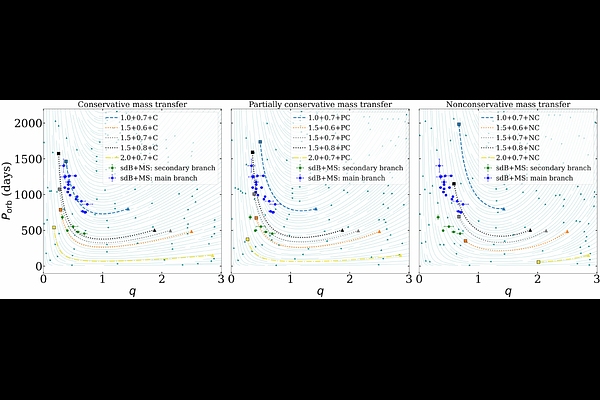
AbstractObservations of wide post-interaction binaries show an unexpected feature; orbital eccentricity, which is not understood theoretically. A promising resolution to this long-standing puzzle is eccentric mass transfer (MT). Here the first complete framework for MT in orbits with arbitrary eccentricity, the general mass-transfer (GeMT) model, is confronted with the latest observations of hot subdwarfs of spectral type B (sdB) with main-sequence (MS) companions in wide orbits. SdBs are excellent benchmarks for binary evolution models, since their progenitors provide unique constraints on their formation histories. We show that the GeMT model naturally reproduces all orbital parameters of wide sdB+MS binaries without fine-tuning and that nonzero eccentricity is a natural outcome of MT. We further demonstrate that post-MT eccentricities depend directly on key MT parameters, including transferred mass, accretion efficiency, and angular momentum loss. Given the multitude of eccentric post-MT binaries with components ranging from low- to high-mass stars to compact objects, we propose that post-MT eccentricities offer a new window onto binary evolution, presenting a powerful tool to constrain highly uncertain binary-evolution parameters and mass-transfer formation histories across diverse populations. Post-MT eccentricity should therefore be embraced as a key observable, rather than treated as a problem to be corrected.